
Most expat finance advice falls into one of two traps. Either it’s written by someone who visited Mexico for three weeks and extrapolated a lifestyle, or it’s generic personal finance content with the word “expat” sprinkled on top.
This guide is neither. I’m an engineer and permanent resident living in San Luis Potosí, and I’ve spent years building wealth across two currencies, two tax systems, and two financial cultures, earning in pesos and dollars, banking in both, and investing while living abroad full-time.
Everything below is what I actually do, what I’ve gotten wrong, and what I’d tell a friend arriving in Mexico tomorrow with a suitcase and a plan.
Here’s the core idea before we get into the details: building wealth as an expat in Mexico isn’t about finding secret loopholes.
It’s about setting up boring, reliable systems early: banking, budgeting, investing, and tax hygiene so the lower cost of living actually converts into assets instead of lifestyle inflation.
Let’s build those systems, one layer at a time.
Want the shortcut?
I’ve condensed this entire framework into the free Expat Wealth Starter Kit checklists, account comparison sheets, and my dual-currency budget template. Grab it here and follow along as you read.
Why Mexico Is a Genuine Wealth-Building Opportunity (Not Just a Cheap Place to Live)
The standard pitch is “your dollars go further in Mexico.” True, but incomplete. The real opportunity is the arbitrage between income and cost of living, and it only becomes wealth if you capture the gap.
If you earn $4,000 USD per month remotely and your comfortable all-in cost of living in a mid-sized Mexican city is $1,800–$2,200 USD, you have a savings rate most people in the US or Canada can only dream about.
A 45–55% savings rate, invested consistently, compresses a 40-year retirement timeline into 15–20 years.
But that gap closes fast if you don’t manage it deliberately. Expats leak money through currency conversion fees, ATM charges, double-paying for services, lifestyle creep in tourist zones, and the big one: leaving money idle in low-yield accounts because investing “feels complicated” from abroad.
The rest of this guide exists to plug those leaks.
Step 1: Banking: Your Financial Foundation in Mexico
Get banking wrong, and everything downstream gets harder. You want three layers:
- A Mexican bank account for daily life (rent, utilities, SPEI transfers, avoiding foreign card fees)
- A multi-currency account as the bridge between your home-country money and pesos
- A home-country account you keep open for credit history, investments, and receiving income
Opening a Mexican Bank Account
With a temporary or permanent resident card, opening an account is straightforward. You’ll typically need your resident card, passport, proof of address (a CFE electricity bill or bank-accepted comprobante de domicilio), and in many cases your RFC (Mexican tax ID) and CURP.
The major traditional banks, BBVA, Santander, Banorte, and HSBC, all work, but the experience varies enormously by branch.
In my experience, BBVA has the strongest app and the widest ATM network, which matters more than most people expect in a country where cash still dominates many transactions.
Don’t overlook Mexico’s fintech scene either. Digital-first options have matured significantly and often pay higher yields on peso balances than traditional banks:
| Option | Type | Best For | Typical Yield on Balances* |
|---|---|---|---|
| BBVA México | Traditional bank | Daily banking, ATM network, SPEI | Low |
| Banorte / Santander | Traditional bank | Branch service, payroll accounts | Low |
| Nu México | Fintech (SOFIPO) | High-yield peso savings, credit building | High |
| Klar / Stori | Fintech | Cashback, building Mexican credit | Moderate–High |
| Hey Banco. | Digital bank | App-first banking with investment options | Moderate–High |
*Yields change frequently; verify current rates before opening anything. Fintech deposits under a SOFIPO license carry different (lower) deposit insurance limits than full banks under IPAB, so keep large balances at fully licensed institutions.
My setup
A traditional bank account for rent and SPEI transfers, plus a fintech account where peso savings earn a real yield instead of sitting dead.
The Multi-Currency Bridge: Wise and Friends
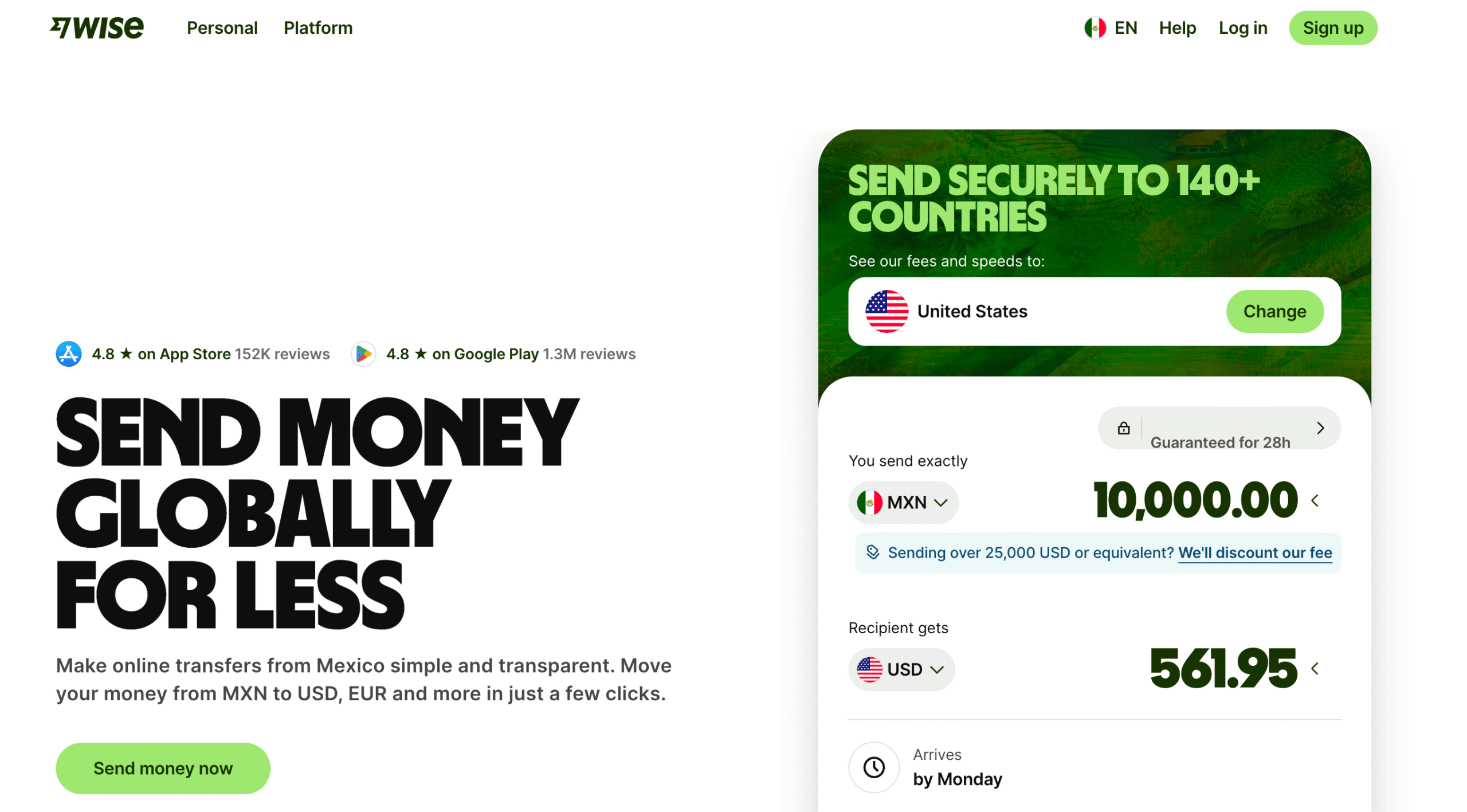
The single most expensive habit among new expats is moving money through their home bank’s international wire system or pulling everything from ATMs with foreign cards.
Between exchange-rate markups and fees, you can quietly lose 3–6% of everything you move. At $30,000 a year, that’s $900–$1,800 gone every year.
A multi-currency account solves this. I use Wise as the hub of my entire system: affiliate and business income lands in my Wise USD account, and I convert to pesos at the mid-market rate only when I need to, sending directly to my Mexican accounts via SPEI. Payoneer plays a similar role for certain income platforms.
The principle matters more than the brand: never let your home bank set the exchange rate.
Keep Your Home-Country Banking Alive
Do not close your US, Canadian, or European accounts when you move. You’ll want them for:
- Maintaining your credit history and credit cards
- Receiving income, refunds, and tax payments
- Funding brokerage accounts (more on this in the investing section)
Keep at least one checking account and one or two credit cards active; use a family member’s address or a mail service if needed; and check your bank’s policies on foreign residency, as some institutions are stricter than others.
Step 2: Budgeting in Two Currencies (Without Losing Your Mind)
Dual-currency budgeting breaks most budgeting apps and most people’s mental math. When the peso swings 10% against the dollar, which happens, your “budget” can drift by hundreds of dollars a month without you spending differently at all.
Here’s the framework that fixed it for me.
Pick One Reporting Currency
Choose a single currency in which you measure your finances, usually the currency of your income or your investments. For most readers, that’s USD.
You’ll still spend in pesos daily, but every account, every budget category, and your net worth gets translated into your reporting currency at a consistent monthly rate.
This one decision eliminates 80% of the confusion. You stop asking, “Am I doing well in pesos or in dollars?” and start seeing one clear picture.
Split Your Budget Into Currency-Native Buckets
Some expenses are structurally peso expenses (rent, groceries, utilities, transport). Others are structurally dollar expenses (subscriptions, flights home, US insurance, investments). List them separately:
| Bucket | Currency | Examples | Conversion Strategy |
|---|---|---|---|
| Local living | MXN | Rent, food, utilities, transport | Convert 1–2 months ahead |
| International fixed | USD | Software, streaming, insurance, flights | Pay from USD account directly |
| Savings & investing | USD (usually) | Brokerage contributions, emergency fund | Never convert to MXN unnecessarily |
| Fun/travel | Mixed | Restaurants, trips within Mexico | Peso budget, hard monthly cap |
The key move: pay dollar expenses from dollar balances and peso expenses from peso balances. Every unnecessary conversion is a fee, and converting back and forth is how people burn 1–2% of their income for nothing.
Manage Exchange-Rate Risk Like an Adult
You can’t predict the peso. What you can do.
Convert in tranches, not lump sums
I convert roughly what I need for the next 30–60 days of peso expenses. This averages out the rate over time: dollar-cost averaging applied to currency.
Convert opportunistically within reason
When the rate moves meaningfully in your favor, it’s fine to top up your peso buffer to 2–3 months. Just don’t turn it into currency speculation.
Never hold your long-term savings in the currency you merely spend
Your wealth should live in the currency of your investments and future obligations, not in whatever your debit card happens to draw from.
A strong peso stretch (and Mexico has had them) can quietly raise your cost of living in dollar terms by 15–20%.
If your budget has no buffer, that’s the difference between saving and treading water, which is exactly why the next section exists.
Step 3: Your Emergency Fund: The Expat Edition
The standard advice is 3–6 months of expenses. As an expat, I’d push you toward 6 months minimum, and here’s the reasoning: your emergency scenarios are bigger.
A family emergency back home means last-minute international flights. A visa complication can interrupt income.
A health event might mean paying a private hospital up front and claiming insurance later. None of these are $500 problems.
Structure It in Two Layers
Layer 1: Peso buffer (1–2 months of local expenses).
Held in Mexico, instantly accessible, ideally in a high-yield fintech or bank account. This covers local emergencies without touching your core fund or making a panicked conversion at a bad rate.
Layer 2: Core emergency fund (4–6+ months).
Held in your reporting currency (usually USD) in a high-yield savings account or money-market fund back home or in a multi-currency account. This is the fund that covers flights, medical events, income gaps, and relocations.
Why split it this way? Because emergencies don’t wait for good exchange rates. If your entire fund sits in pesos and the peso is weak when disaster strikes back home, your fund just shrank at the worst possible moment. Holding the core in your reporting currency matches the fund to the risks it actually covers.
One more expat-specific note
Your emergency fund is not your visa fund. If you’re maintaining residency requirements that involve demonstrating solvency, treat that as a separate, untouchable line item.
Step 4: Investing While Living Abroad
This is where most expats stall and where the real wealth gets built or lost. The good news: living in Mexico does not lock you out of world-class investing. The bad news: doing it wrong can create genuine tax and access problems.
Quick disclaimer
I’m an engineer sharing my own experience, not a financial advisor or tax professional. Treat this as a map, not personalized advice.
Rule 1: Keep It Simple and Keep It (Mostly) Where Your Tax Life Is
For US citizens especially, the cleanest path is usually to keep investing through US brokerages in US-domiciled index funds and ETFs. US citizens face punishing tax treatment (PFIC rules) on most foreign mutual funds and ETFs, so buying investment products through a Mexican brokerage is usually a mistake for Americans even while living in Mexico full-time.
For Canadians, Brits, Europeans, and others, the calculus differs based on your home country’s rules and whether you’ve become a non-resident for tax purposes there.
The universal principle: understand where you are a tax resident before you decide where to invest.
Rule 2: Solve the Brokerage Access Problem Early
Some brokerages restrict or close accounts when they learn you live abroad. Others are explicitly expat-friendly.
Interactive Brokers is the most commonly used option among expats worldwide precisely because it operates internationally and doesn’t panic when your address is in Mexico. Charles Schwab also has an international arm many US expats use.
Practical tips from the trenches:
- Sort your brokerage situation before you move if you can.
- Understand your broker’s actual policy on foreign addresses rather than relying on forum rumors; policies change.
- Don’t lie about your address. It can void protections and create real legal problems. Choose an institution that accepts your situation instead.
Rule 3: The Portfolio Itself Should Be Boring
The expat part of your life is complicated enough. The portfolio shouldn’t be. A simple three-piece structure covers the vast majority of situations:
- A global or US total-market index fund/ETF, the growth engine
- A bond or fixed-income allocation appropriate to your age and risk tolerance
- Cash reserves (your emergency fund, already handled above)
Automate contributions monthly from your income, in your investment currency, before you convert anything to pesos. Pay yourself first, then fund your Mexican life with what remains.
What About Investing in Mexico?
Mexican assets can play a role. CETES (Mexican government treasury bonds, buyable directly through Cetesdirecto) have offered attractive peso yields in recent years, and Mexican real estate is the classic expat move. Two cautions:
CETES yields are peso yields
A high nominal rate partly compensates for peso inflation and currency risk. They’re a reasonable home for your peso buffer, not a replacement for a global portfolio.
Real Estate
Real estate in Mexico deserves its own guide (restricted-zone rules, fideicomisos, ejido land risks, and the fact that property here is a much less liquid market than back home).
Buy because you understand the market and want the asset, never because “everyone says real estate in Mexico is a goldmine.”
Step 5: Taxes: The High-Level Map (Get a Professional for the Details)
I’m going to keep this section deliberately high-level, because expat taxation is genuinely a two-professional problem: one advisor who knows your home country’s rules, and one who knows Mexico’s. But you need the map before you can use the guides.
The Three Questions That Define Your Situation
Are you a Mexican tax resident?
Mexico generally considers you a tax resident if your primary home is in Mexico, with a “center of vital interests” test (where your income comes from and where your life is based) as the tie-breaker.
Tax residency is separate from immigration status; you can be a permanent resident for immigration purposes and still need to work out your tax residency carefully, and vice versa.
Does your home country still tax you?
US citizens are taxed on worldwide income no matter where they live, full stop. That means annual US filings, plus reporting obligations like FBAR for foreign accounts above the threshold.
Canadians, Brits, and Australians can generally exit their home tax systems by properly establishing non-residency, but it must be done deliberately.
Is there a treaty preventing double taxation?
Mexico has tax treaties with the US, Canada, and many other countries. Between treaties, foreign tax credits, and (for Americans) the Foreign Earned Income Exclusion, most expats do not end up taxed twice on the same income, but only if things are filed correctly on both sides.
If You Earn Income While in Mexico
If you work for Mexican clients, run a business here, or are a tax resident with worldwide income, you’ll be dealing with SAT (Mexico’s tax authority): getting an RFC, choosing a tax regime, issuing facturas (CFDI electronic invoices), and likely making monthly declarations.
Mexico’s system is more digitized and more invoice-driven than most newcomers expect, and a good local contador (accountant) is inexpensive relative to the errors they prevent.
The one-sentence takeaway
Budget a few hundred dollars a year for professional tax help on both sides of the border. It is the highest-ROI “investment” in this entire guide.
Step 6: Retirement Planning From Mexico
Retirement planning as an expat has two halves: keeping your home-country retirement machinery running and deciding what role Mexico plays in the destination.
Keep the Home-Country Machinery Running (Where You Can)
US expats
You can generally keep and grow existing IRAs and 401(k)s. Contributing new money to an IRA requires taxable compensation, and if you exclude all your income via the Foreign Earned Income Exclusion, you may have excluded your ability to contribute.
Many expats use the foreign tax credit route instead, partly for this reason. This is exactly the kind of interaction a professional should optimize for you.
Canadians
RRSPs and TFSAs have specific non-residency rules. RRSPs can usually be kept (not contributed to), while TFSA contributions as a non-resident trigger penalties.
Everyone
Understand what happens to your state pension / Social Security / CPP entitlements while abroad. Social Security, for example, is generally payable to US citizens living in Mexico; your earned benefits typically follow you.
The Mexican Side of the Equation
Living in Mexico changes retirement math in your favor in one enormous way: the number you need is smaller.
If a comfortable retirement in the US requires $70,000–$80,000 a year, an equivalent (often better) lifestyle in Mexico might run $30,000–$45,000.
Using a 4% withdrawal framework, that’s the difference between needing ~$2 million and needing ~$900,000–$1.1 million.
That’s not a rounding error. That’s a decade or more of your life back.
Things to build into your Mexico retirement plan:
Healthcare strategy
Private health insurance in Mexico, IMSS enrollment where eligible, and/or a medical-tourism-plus-catastrophic approach. Healthcare is dramatically cheaper here, but you still need a deliberate plan, and private insurance gets expensive to start at older ages and enroll earlier rather than later.
Residency durability
Permanent residency removes the risk of renewal from your retirement plan. If you’re on temporary residency, map the path to permanent.
Estate basics across borders
A will that covers your Mexican assets (a Mexican will for Mexican property is standard advice), beneficiary designations updated on all accounts, and clarity on how your home country and Mexico treat inheritance.
The 7 Most Common Wealth-Killing Mistakes Expats Make in Mexico
After years here and years writing about expat finance, these are the failures I see over and over:
Paying the exchange-rate tax forever
Using home-bank wires and foreign-card ATM withdrawals as a permanent system instead of a first-month stopgap. Fix: multi-currency account + SPEI, from month one.
Lifestyle inflation that eats the arbitrage
Moving here to save money, then renting the $2,500/month condo in a tourist zone and living an imported lifestyle at imported prices. The savings rate — not the geography — is what builds wealth.
Going all-cash and calling it “safe.”
Years of savings sitting in a zero-interest account (in either currency) while inflation compounds against you. Idle money in a high-inflation environment isn’t safe; it’s a slow leak.
Buying foreign investment products without checking home-country tax treatment
The classic version: a US citizen buying Mexican mutual funds and discovering the PFIC nightmare at tax time.
Ignoring tax filings back home
Especially Americans who assume that leaving the US means leaving the IRS. Penalties for missed informational filings (like FBAR) can be brutal even when no tax was owed.
Buying property too fast
Purchasing real estate in year one, before understanding the market, the legal structures, or even whether you’ll love the city in year three. Rent first. The market will still be there.
Having no repatriation plan
Life changes, family, health, and opportunity. If all your assets are illiquid, peso-denominated, or structurally stuck in Mexico, an unplanned move home becomes a financial crisis instead of a logistics exercise.
Every one of these is avoidable with the systems in this guide. None of them is avoidable with optimism alone.
Your 90-Day Expat Wealth Setup Plan
If you’re starting from zero, here’s the sequence:
Days 1–30: Foundation
Open a Wise (or similar) multi-currency account. Open a Mexican bank account once you have your resident card. Set up SPEI transfers between them. Keep home-country accounts alive.
Days 31–60: Systems
Build your dual-currency budget with one reporting currency. Establish the peso buffer (1–2 months) and start filling the core emergency fund. Confirm your brokerage works with a foreign address or move to one that does.
Days 61–90: Growth
Automate monthly investment contributions in your investment currency. Book one consultation each with a home-country expat tax professional and a Mexican contador. Write down your target savings rate and your “Mexico number” for financial independence.
That’s it. Not glamorous but eighteen months from now, the gap between the expats who did this and the ones who “will get to it” is measured in tens of thousands of dollars.
FAQ: Building Wealth as an Expat in Mexico
Can I open a bank account in Mexico as a foreigner?
Yes. With a temporary or permanent resident card, passport, and proof of address, you can open accounts at major banks like BBVA, Santander, and Banorte.
Some fintechs are accessible with even lighter requirements, though a CURP/RFC is increasingly requested.
Do I pay taxes in Mexico or my home country?
Potentially both, depending on tax residency and citizenship, but tax treaties, foreign tax credits, and exclusions mean most expats aren’t taxed twice on the same income when filings are done correctly.
US citizens must file US returns regardless of where they live. Get professional advice on both sides.
Is it better to keep my money in pesos or dollars?
Spend in pesos; save and invest primarily in your reporting/investment currency (usually USD or EUR). Hold 1–3 months of peso expenses locally and convert in tranches rather than lump sums.
Can I invest in US index funds while living in Mexico?
Generally yes, through expat-friendly brokerages such as Interactive Brokers or Schwab’s international options. Confirm your broker’s foreign-address policy and never misrepresent where you live.
How much do I need to retire in Mexico?
Many expats live comfortably on $2,500–$3,800 USD per month. Using a 4% withdrawal framework implies a portfolio of roughly $750,000–$1.15 million, often half of what an equivalent lifestyle requires in the US or Canada. Your number depends on city, healthcare plan, and lifestyle.
How big should my emergency fund be as an expat?
At least six months of expenses, split between a local peso buffer (1–2 months) and a core fund in your reporting currency for large emergencies like flights home, medical events, or income gaps.
Get the System, Not Just the Article
You now have the full map: banking layers, dual-currency budgeting, a two-layer emergency fund, an investing framework that survives borders, the tax questions to bring to a professional, and the retirement math that makes Mexico such a powerful place to build wealth.
The map is free. Executing it is where wealth actually happens, and execution is easier with the templates in hand.
📥 Download the free Expat Wealth Starter Kit, my account-comparison worksheet, dual-currency budget template, 90-day setup checklist, and emergency fund calculator, built from the exact system I use as a permanent resident here.
And if you want the deep version, every topic in this guide is expanded into a full playbook, including the residency, healthcare, and real estate chapters that didn’t fit here. The complete 18-chapter Expat Wealth Guide is available here.