Moving abroad breaks most personal finance advice before you even unpack your first box. Budgeting apps built for one country and one currency start showing you numbers that don’t mean anything the moment you’re earning in USD, spending in MXN, and watching both currencies move against each other every week.
I ran into this problem the hard way. As an industrial automation engineer working in San Luis Potosí, with side income coming in from content sites and affiliate payouts on top of my regular paycheck, I had money entering and leaving through more channels than any single app wanted to track cleanly.
So I built my own system, simple enough to update in a few minutes a week but complete enough that I can answer “Where did my money actually go this month?” without guessing.
This is that system, laid out step by step.
Why Expat Money Tracking Is Different
Before the system itself, it’s worth naming exactly why standard budgeting advice falls short for expats.
Multiple currencies
Income, savings, and spending rarely live in the same currency, and exchange rates shift daily.
Multiple accounts across borders
A home-country bank account, a local bank account, and often a multi-currency platform like Wise or Payoneer all need to be counted together, not separately.
Irregular income streams
Freelance work, remote contracts, or online business income (affiliate payouts, for example) often don’t land on a predictable schedule.
Tax exposure in two places
What counts as “income” for your home country’s tax authority and your host country’s tax authority isn’t always the same, and the paperwork trail matters.
Cost-of-living whiplash
A dollar or euro can buy a very different amount of daily life depending on where you’re spending it, which makes generic budgeting percentages nearly useless.
A system that ignores any one of these will eventually give you a false sense of control, with numbers that look tidy but don’t reflect reality.
The Core Principle: One Base Currency, Every Transaction
The foundation of my system is simple: everything gets converted into a single base currency before it goes anywhere near a budget.
I use USD as my base, since it’s the currency most of my income streams originate in and the one I think in when planning long-term.
If most of your income and long-term goals are anchored to a different currency, use that instead. The principle matters more than the specific currency.
Every transaction, regardless of which account or currency it started in, gets logged at the exchange rate on the day it happened.
This one habit solves 80% of the confusion expats run into, because it means your monthly totals are always comparable to each other, month over month, no matter how the peso-dollar rate moved in between.
The Simple System, Step by Step
List Every Account You Touch
Start with a single master list of every account that money moves through: home bank account, local bank account, Wise or Payoneer, credit cards, and any business or affiliate payment platforms.
Most expats underestimate this number until they write it down. I count six regularly active accounts, and missing even one creates a blind spot in the total picture.
Pick One Tracking Tool and Keep It Boring
I use a single spreadsheet, not an app. Apps built for one-currency users tend to fight you the moment a second currency enters the picture, and I’d rather spend ten minutes a week on a spreadsheet I fully control than fight software.
A spreadsheet also travels with you if you switch banks or countries, which matters more for expats than most guides admit.
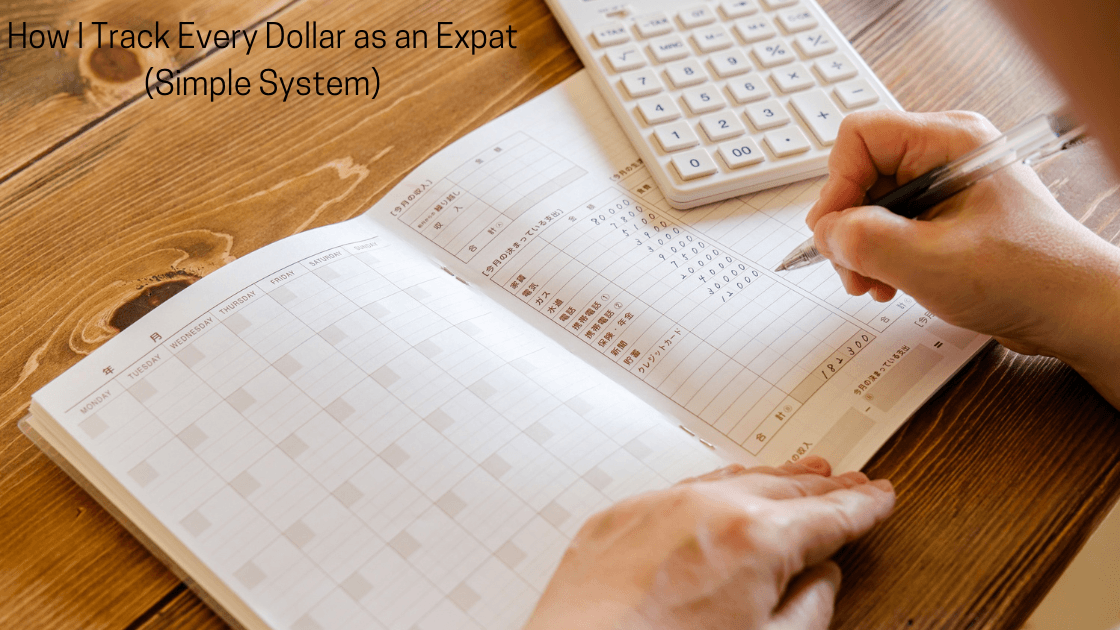
The sheet has four columns that do all the work: date, description, category, and amount in base currency. That’s it. Complexity is the enemy of consistency.
Log Transactions Weekly, Not Daily
Daily tracking sounds disciplined but rarely survives contact with a busy work schedule. I set a recurring 15-minute block every Sunday to pull transactions from every account and log them. Weekly batching is frequent enough to catch problems early and infrequent enough that I actually do it.
Categorize by Function, Not by Country
Instead of separate categories for “Mexico expenses” and “home country expenses,” I categorize by function: housing, food, transportation, savings, business costs, and taxes.
This keeps the system focused on what the money is actually doing for me, rather than fragmenting the picture by geography.
Convert at the Real Rate, Not a Guess
For each transaction, I record the exchange rate that actually applied, the rate my bank or Wise charged, not the mid-market rate quoted in the news.
The spread between those two numbers adds up over a year, and tracking the real rate is what makes the system trustworthy instead of just tidy-looking.
Review Monthly Against a Simple Baseline
At the end of each month, I total each category and compare it to the prior month and to a rough target range I set for myself.
I’m not chasing a rigid budget down to the peso. I’m watching for drift, the kind that creeps in quietly when a new subscription or a currency swing distorts a category without you noticing.
Handling Irregular and Business Income
If part of your income comes from freelance work, remote contracts, or an online business, treat it as a separate income stream inside the same sheet rather than folding it into a monthly average.
Irregular income tracked honestly and logged the month it actually arrives, not smoothed out, gives you a much clearer read on your real cash flow than a projected average ever will.
This also makes tax season considerably less painful, because the paper trail already exists in one place instead of scattered across platforms.
A Note on Taxes
Tracking spending is only half the job. As an expat, keeping a clean record of where income originated and when it landed is what makes tax filing manageable in either country.
I keep a separate tab in the same sheet just for income source, currency, and date received. Nothing fancy, but it turns tax season into a copy-paste job instead of a reconstruction project.
This isn’t tax advice, and rules vary significantly depending on your home country, your host country, and your visa or residency status.
A qualified accountant familiar with both jurisdictions is worth the cost. But no accountant can help you if the underlying records don’t exist.
Tools That Support This System
| Tool | Role in the System | Why It Fits |
|---|---|---|
| Spreadsheet (Google Sheets or Excel) | Central ledger, base-currency conversion | Full control, no subscription, works across any currency combination |
| Wise | Multi-currency holding and transfers | Transparent real exchange rates, easy to export transaction history |
| Payoneer | Receiving international payments | Common payout method for affiliate and freelance income |
| Local bank app | Day-to-day spending source data | Direct export of local-currency transactions |
| Calendar reminder | Weekly logging habit | Consistency matters more than the tool |
Common Mistakes I See Expats Make
Tracking in two currencies side by side without converting
This creates the illusion of tracking without the substance of it. You end up with two sets of numbers that can’t be compared.
Using the mid-market rate instead of the real transaction rate
It flatters your numbers but hides real cost.
Waiting for tax season to reconstruct income history
By then, half the context is gone.
Over-engineering the system
A dozen categories and three apps syncing with each other is a system you’ll abandon within a month. Simple systems survive; complex ones don’t.
FAQ
What’s the best currency to track expenses in as an expat?
Use whichever currency most of your income and long-term financial goals are anchored to. For most expats, that’s their home currency, but if you’re building a life and income primarily in your host country, tracking in the local currency can make more sense.
Do I need a separate app for multi-currency tracking?
Not necessarily. A well-structured spreadsheet with a consistent base-currency conversion habit can outperform most budgeting apps, especially since it adapts instantly to new accounts or currencies without waiting on app updates.
How often should I actually log transactions?
Weekly is the sweet spot for most people, frequent enough to catch problems early and infrequent enough to actually stick with long-term.
Should business or freelance income be tracked differently from personal spending?
Yes. Keep it as a distinct stream with its own source, currency, and date-received data. It keeps your monthly totals accurate and makes tax preparation far simpler.
Is tracking exchange rate spread really worth the effort?
Over a single transaction, no. Over a year of regular transfers, the spread between the real rate you’re charged and the mid-market rate can add up to a meaningful amount, worth knowing even if you decide not to act on it.