
If you earn affiliate income in Mexico, the way you structure your bank accounts matters just as much as the commissions themselves.
Get it wrong, and you’ll bleed money on currency conversion, mix personal and business funds into an accounting mess, and create headaches when the SAT comes asking questions.
Get it right, and every peso flows through a clean, traceable, low-fee pipeline from your affiliate networks to your pocket.
I’ve been earning affiliate commissions from US-based networks while living in Mexico for years, and I’ve made most of the mistakes so you don’t have to, including letting an ad network deposit USD directly into my Mexican payroll account (more on why that’s a bad idea below).
In this guide, I’ll show you exactly how to structure bank accounts for affiliate income in Mexico, layer by layer.
Disclaimer
I’m an engineer and entrepreneur, not an accountant or financial advisor. This article shares my experience and research. Always confirm tax and banking decisions with a Mexican accountant.
Why Account Structure Matters for Affiliate Marketers in Mexico
Affiliate income in Mexico has three characteristics that make banking structure critical:
It arrives in foreign currency
Amazon Associates, ClickBank, Digistore24, AdSense, and most other networks pay in USD (or EUR). Every conversion to pesos has a cost, and that cost varies wildly depending on who does the converting.
It comes from multiple sources on different schedules
One network pays via Payoneer, another via PayPal, and another via direct deposit. Without a deliberate structure, your income scatters across platforms.
SAT expects clean records
Whether you operate as a persona física con actividad empresarial, under RESICO, or through an SAS, the tax authority wants to see business income clearly separated from personal spending.
A good structure solves all three problems at once. Here’s the framework.
The Three-Layer Account Structure
Think of your banking setup as three layers, each with a specific job:
| Layer | Purpose | Typical tools |
|---|---|---|
| Layer 1: Receiving accounts | Collect USD/EUR from affiliate networks at the lowest cost | Wise, Payoneer, PayPal |
| Layer 2: Mexican business account | Hold business funds in MXN, pay business expenses, anchor your SAT records | Business account at a Mexican bank or fintech |
| Layer 3: Personal account | Receive your “salary” from the business; everyday spending | Your existing personal/nómina account |
Money should flow in one direction: network → receiving account → business account → personal account. Every hop is documented, and each layer does what it’s best at.
Layer 1: USD Receiving Accounts (Wise, Payoneer, PayPal)
Never let an affiliate network convert your USD to MXN for you if you can avoid it. Network-side and bank-side conversions routinely cost 2–4% in hidden spread. On $2,000 USD a month, that’s up to $80 vanishing every month.
Instead, open accounts that give you local USD receiving details (a US routing number and account number):
Wise
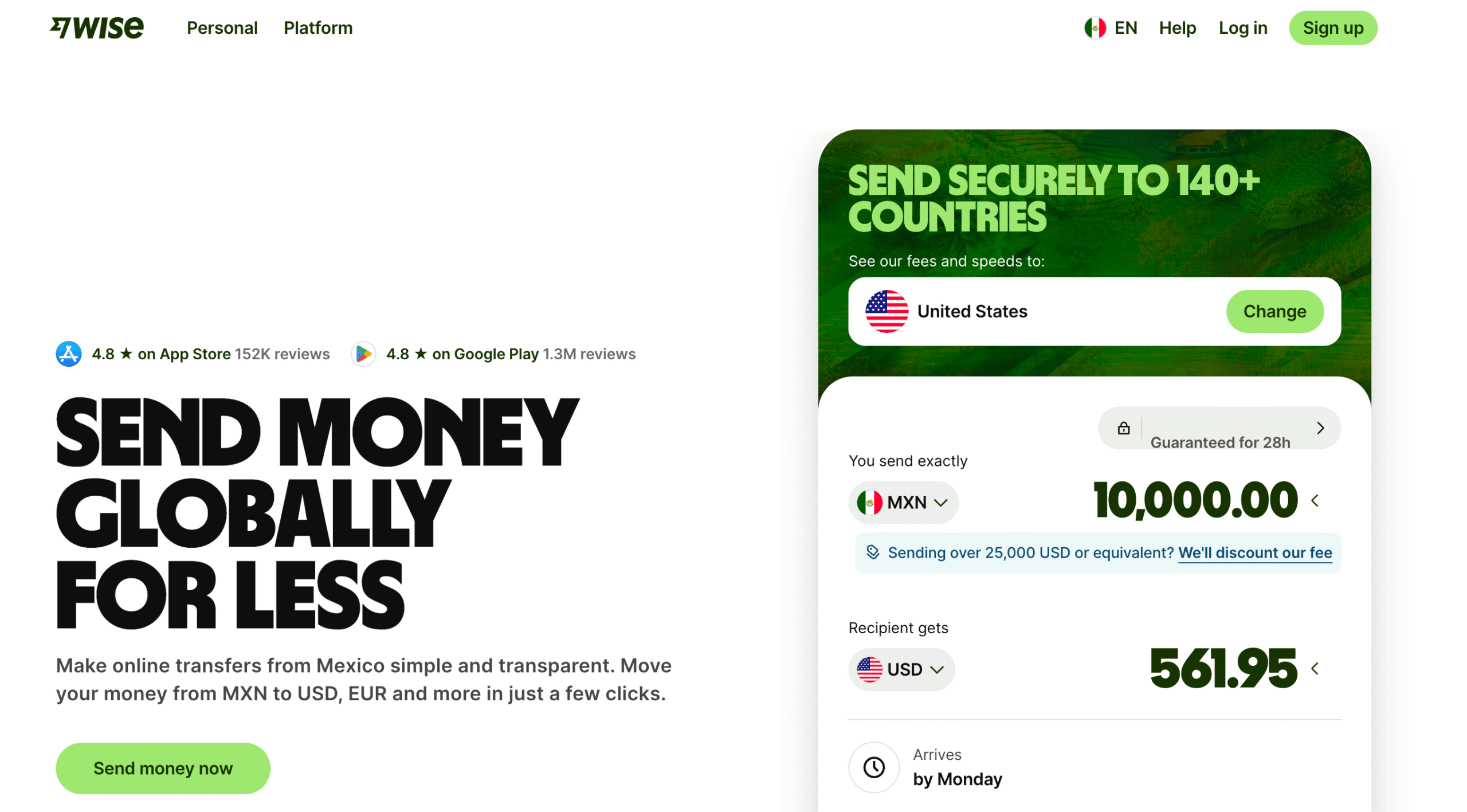
My workhorse. You get US account details for ACH deposits, the mid-market exchange rate, and transparent fees (typically well under 1%) when converting to MXN. Wise can send pesos directly to any Mexican bank account via CLABE.
Payoneer
Essential because some networks integrate with it natively. Amazon, for example, pays international associates smoothly through Payoneer.
Fees are higher than Wise, so I treat Payoneer as a collection point and move funds out rather than converting there.
PayPal
Unavoidable for certain networks like Digistore24. PayPal’s currency conversion is among the most expensive, so withdraw strategically and keep balances low.
Practical tip
Match each network to its cheapest available payout channel. My own mapping looks like this: Amazon → Payoneer; Digistore24 → PayPal; and anything that supports ACH direct deposit → a Wise USD account. Review each network’s payout settings once. It’s a 10-minute task that saves hundreds of dollars a year.
Layer 2: The Mexican Business Account
This is the layer most affiliate marketers in Mexico skip, and it’s the one SAT cares about most.
Once your affiliate income becomes consistent, you’ll formalize with SAT (as a persona física con actividad empresarial, under the RESICO regime, or eventually through a company such as a SAS (Sociedad por Acciones Simplificada)).
Whichever regime you choose, you need one dedicated Mexican account where all business income lands and all business expenses leave.
Why a dedicated account?
Clean CFDI reconciliation
Every deposit matches an invoice you issued; every outflow matches a deductible expense. Your accountant will love you.
Audit protection
If SAT ever reviews your declarations, a single-purpose account tells a coherent story. Business income mixed into a personal account looks like discrepancies waiting to be questioned.
Deductibility
Hosting, SEO tools, design software, and other business expenses paid from the business account (with matching CFDIs where applicable) are far easier to defend as deductions.
What to look for in a Mexican business account for affiliate income
| Criterion | Why it matters |
|---|---|
| Accepts international transfers easily | Some digital-first banks flag or reject foreign inflows; traditional banks tend to be more comfortable with them |
| Reasonable or zero monthly fees | Affiliate income fluctuates; don’t pay for the account in slow months |
| SPEI access and a CLABE | Needed to receive Wise/Payoneer withdrawals and pay Mexican vendors |
| Solid online banking | You’ll manage everything remotely |
| Compatible with your entity type | Business accounts for an SAS require the company’s RFC and e.firma; get those first |
If you operate through an SAS, note the sequencing: you need the company’s RFC and e.firma from SAT before any bank will open the account, and it’s worth letting the e.firma activate fully (in a day or two) before your bank appointment. Bring your acta constitutiva, proof of fiscal address, and ID.
One mistake to avoid
Don’t let networks deposit directly into your personal payroll account. I did this with an ad network early on.
It converts at the bank’s poor rate, mixes business income into personal banking, and complicates your tax picture.
If any network is currently paying into your personal account, redirect it to Layer 1 or your business account.
Layer 3: Your Personal Account
Keep the personal account you already have. This layer needs no optimization. Its only job in the structure is to receive a regular transfer from your business account (think of it as paying yourself) and handle daily life.
Paying yourself on a schedule, say, a fixed amount on the 1st of each month, does two useful things: it smooths out the natural volatility of affiliate income, and it forces the business account to accumulate a buffer for taxes and slow months.
The Currency Conversion Strategy
Where you convert USD to MXN is a decision point, not an automatic step. Three approaches:
Convert on arrival
Simple: every payout gets converted via Wise and sent to your Mexican business account. Best when you need the pesos for expenses and want zero FX exposure.
Hold USD and convert in batches
Keep balances in your Wise USD account and convert when you need pesos or when the rate is favorable. Fewer conversions also means fewer transfer fees.
Hybrid (my approach)
Convert each month enough to cover Mexican expenses and tax provisions; hold the surplus in USD as a natural hedge.
Living in Mexico with peso expenses but a dollar income is a genuine advantage. Structure your accounts to preserve it.
Whatever you choose, always compare the rate you’re offered against the mid-market rate on Google. If the difference exceeds about 1%, someone is taking too big a cut.
Setting Aside Taxes Automatically
Affiliate income arrives gross. No employer is withholding ISR for you. Build the provision into the structure:
- Every time money lands in your business account, mentally (or literally, via a sub-account) tag 25–35% for taxes, depending on your regime and your contador’s guidance. RESICO rates are lower; general regime and corporate rates are higher.
- Remember that Mexican provisional payments are monthly, not annual. Your business account should always hold enough to cover the next declaration.
- Issue CFDIs for your income as your regime requires, and keep the amounts aligned with what actually hits the account.
Recommended Setup by Stage
| Stage | Monthly affiliate income | Recommended structure |
|---|---|---|
| Starting out | Under ~$500 USD | Wise + your personal account; register with SAT as actividad empresarial when income is recurring |
| Growing | ~$500–$3,000 USD | Wise + Payoneer + dedicated Mexican account (RESICO is often ideal here); strict separation of funds |
| Established | $3,000+ USD | Consider an SAS with a proper business bank account, USD holding strategy, and an accountant on retainer |
Step-by-Step: Setting Up the Full Structure
- Open a Wise account and activate USD account details (routing + account number).
- Open Payoneer if any of your networks (like Amazon) pay through it.
- Update payout settings in every affiliate network to point to the cheapest channel.
- Register or update your situation with SAT. Choose your regime with a contador’s input.
- Open your dedicated Mexican business account (after RFC and e.firma if you’re using a SAS).
- Route everything: networks → receiving accounts → business account.
- Set a monthly “salary” transfer from business to personal.
- Provision for taxes on every deposit and reconcile monthly with your CFDIs.
Frequently Asked Questions
Can I receive affiliate income directly into a Mexican bank account?
Technically yes, but it’s usually the most expensive option. Direct international deposits into Mexican banks trigger poor exchange rates and sometimes incoming wire fees. Routing through Wise or Payoneer first almost always nets you more pesos.
Do I need a business account for affiliate income in Mexico?
Not legally at low income levels, but practically yes once income is consistent. SAT expects your declared income to be traceable, and a dedicated account makes reconciliation, deductions, and any future audit dramatically simpler.
Is Wise legal to use in Mexico?
Yes. Wise operates transfers into Mexico via SPEI to any CLABE. It’s a money transfer service, not a Mexican bank, so treat it as a conduit, not a place to store large balances long-term.
Should I hold my affiliate earnings in USD or MXN?
If your expenses are in pesos, convert what you need and consider holding some surplus in USD as a hedge. There’s no universally right answer. It depends on your risk tolerance and upcoming expenses.
What tax regime is best for affiliate marketers in Mexico?
Many individual affiliates fit well under RESICO (Régimen Simplificado de Confianza) thanks to its low rates, subject to its income cap and eligibility rules. Higher earners or those building a brand with partners often move to an SAS. Talk to an accountant. The right answer depends on your numbers.
Do I pay Mexican taxes on income from US affiliate networks?
If you’re a Mexican tax resident, yes, Mexico taxes residents on worldwide income, including foreign affiliate commissions.
The US–Mexico tax treaty helps prevent double taxation, but the income must be declared in Mexico.
Final Thoughts
Structuring bank accounts for affiliate income in Mexico comes down to one principle: every layer should do the job it’s cheapest and cleanest at.
Let Wise and Payoneer handle receiving and conversion, let a dedicated Mexican account anchor your SAT compliance, and let your personal account just be personal.
Set it up once, and the system runs itself, leaving you free to focus on what actually grows your income: building content and traffic.
Related reading: how affiliate marketers in Mexico should track international commissions for SAT, expat financial mistakes to avoid, and the best side hustles for expats in Latin America.