I moved to Mexico as a permanent resident years ago, originally from Tanzania, and I’ve watched a lot of expats arrive with good salaries, solid savings, and absolutely no plan for how money actually works here.
Most of them aren’t reckless people. They’re smart professionals who assume the financial habits that worked back home will travel with them. They don’t.
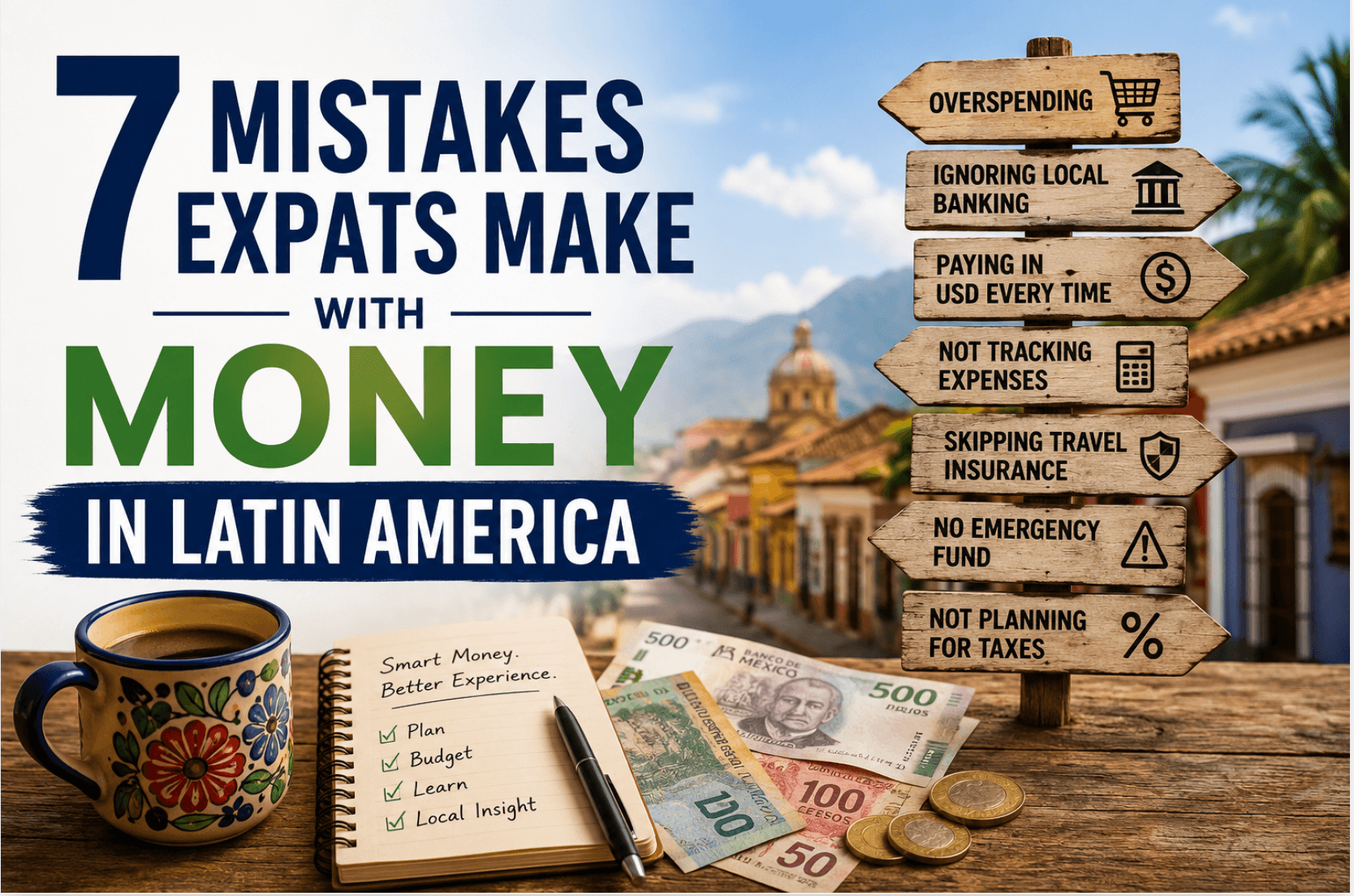
7 Mistakes Expats Make with Money in Latin America
Latin America rewards people who understand the local rules and quietly punishes those who don’t.
The difference between an expat who builds real wealth here and one who bleeds money for years usually comes down to a handful of avoidable mistakes. Below are the seven I see most often and exactly what to do instead.
Losing Money on Every Currency Conversion
This is the silent killer. Most expats receive income in dollars or euros and convert it through their home bank, a high-street exchange house, or, worst of all, the airport.
Each of those routes hides a spread of 2% to 5% on top of any visible fee. Convert a few thousand dollars a month, and you’re handing over hundreds annually for nothing.
The fix is structural, not occasional. Route foreign income through a multi-currency account like Wise or a similar service that converts at the mid-market rate, then move pesos into your local bank only when you need them.
I run affiliate and business income into a USD balance first. Convert deliberately rather than reactively, and watch the exchange rate instead of letting my bank decide for me. Over a year, that discipline alone can be worth a month’s rent.
Keeping All Their Wealth in a Depreciating Local Currency
The opposite mistake is just as common. Some expats arrive, convert everything to the local currency, and park it in a local savings account, earning almost nothing while inflation and depreciation eat it alive.
The Mexican peso, Colombian peso, and Argentine peso have all had brutal stretches against the dollar.
You want balance. Keep enough local currency to live comfortably and cover near-term expenses, but hold the bulk of your long-term wealth in stronger or diversified assets: dollar-denominated investments, index funds through an international brokerage, or hard assets.
The goal isn’t to bet against your new home. It’s to avoid having your entire net worth tied to one volatile currency you didn’t choose for its stability.
Ignoring Local Tax Residency Rules
Here’s where good people get into real trouble. Spend more than 183 days in most Latin American countries, and you likely become a tax resident, which can mean your worldwide income is reportable locally.
Plenty of expats either don’t know this or assume their home country’s taxes cover them. Then a letter arrives.
Mexico, for example, has the SAT and a formal RFC registration process, and the tax authority is far more digitized and aggressive than people expect.
If you’re earning here or even living here full-time on foreign income, get a local accountant in your first year, not your third.
Understand your residency status, your reporting obligations, and any tax treaties between your home country and your new one. The cost of an accountant is trivial next to the cost of a back-tax assessment with penalties.
Treating Local Banks Like Their Home Bank
Banking in Latin America runs on different assumptions. Account opening can require proof of address that’s harder to produce than you’d think, products marketed as “free” are often restricted to certain account types, and the digital experience varies wildly between institutions.
Expats who walk in expecting their home country’s frictionless onboarding leave frustrated and sometimes give up entirely.
Do your homework before you pick an institution. Some banks cater well to foreigners and residents with international needs; others quietly make life difficult.
Know which documents you need: residency card, comprobante de domicilio, RFC, or local tax ID before you show up. And don’t assume one bank does everything well.
Many expats here run a deliberate stack: one institution for daily local spending, another for international transfers, and a separate setup entirely for any business income.
Skipping a Business or Legal Structure When They Should Have One
If you’re earning money in Latin America through freelancing, consulting, running online businesses, or renting property, operating as a loose individual is often the wrong move.
Many countries offer simplified business structures that lower your effective tax rate, make expenses deductible, and protect you legally.
In Mexico, the SAS (Sociedad por Acciones Simplificada) lets you register a company with minimal cost and real advantages.
Expats routinely leave this on the table because it sounds intimidating in a second language. But the paperwork is more navigable than the mythology suggests, and the savings compound.
A proper structure turns your phone bill, software subscriptions, and home office into legitimate deductions instead of pure personal expenses.
If you’re building anything here, treat the legal architecture as part of the wealth plan, not an afterthought.
Failing to Build Local Credit and Financial History
Your home-country credit score does not follow you across the border. You arrive as a financial ghost, with no history, no score, and no relationship with any local institution.
Expats who don’t fix this find themselves unable to get a mortgage, a decent credit card, or favorable terms on anything for years.
Start building local credit deliberately and early. Open accounts, use a local credit card responsibly and pay it in full, and let the institutions see consistent behavior.
In Mexico, products from issuers like Nu, Inbursa, and others make it possible to start a credit profile from scratch.
If your long-term plan includes buying property here, as mine did, the credit history you build in year one is what makes year five possible.
Read: How to Build Credit History in a New Country
Having No Long-Term Wealth Plan for the Family
The biggest mistake isn’t a single transaction. It’s been living here for a decade with no architecture for what happens to your money long-term.
Expats often think in terms of “this year’s income” rather than wealth transfer, succession, and what their children inherit across borders.
Cross-border families have genuinely complicated questions: Which country’s inheritance rules apply? How does property pass to a spouse or child? What happens to assets held in two or three currencies across multiple jurisdictions? These aren’t questions to answer on your deathbed.
Build the plan now: local will, clear ownership structures, designated beneficiaries, and a deliberate strategy for moving wealth to the next generation.
For those of us raising children in a country we adopted, this is the entire point. Income pays for today. Architecture protects the family for generations.
Frequently Asked Questions
Do expats have to pay taxes in Latin American countries?
In most Latin American countries, spending more than 183 days per year typically makes you a tax resident, which can mean your worldwide income becomes reportable locally.
Rules vary by country and depend on tax treaties with your home nation. Consult a local accountant in your first year of residency to understand your specific obligations.
What’s the best way for expats to handle currency conversion in Latin America?
Use a multi-currency account like Wise that converts at the mid-market rate, rather than relying on home banks, exchange houses, or airport kiosks that hide spreads of 2% to 5%.
Convert deliberately based on the exchange rate instead of letting your bank decide automatically.
Can expats build credit in Latin America?
Yes, but your home-country credit score does not transfer. You need to build a local financial history from scratch by opening accounts and using local credit products responsibly. This is essential if you ever want a mortgage or favorable loan terms in your new country.
Should expats keep their money in local currency or dollars?
A balanced approach works best: hold enough local currency for living expenses and near-term needs, but keep the bulk of long-term wealth in stronger or diversified assets to protect against currency depreciation and inflation common in the region.
The Bottom Line
None of these mistakes come from stupidity. They come from assuming Latin America works like home. It doesn’t, and the expats who thrive financially here are the ones who learn the local rules, build deliberate systems, and think in decades rather than months.
Pick one mistake from this list that you recognize in your own situation and fix it this week. Then move to the next.
Wealth in a new country isn’t built in a single dramatic move. It’s built by quietly stopping the leaks that everyone else ignores.
Want the full framework for building real wealth as an immigrant or expat in Latin America? Grab the free Expat Wealth Starter Kit and start with the fundamentals.