
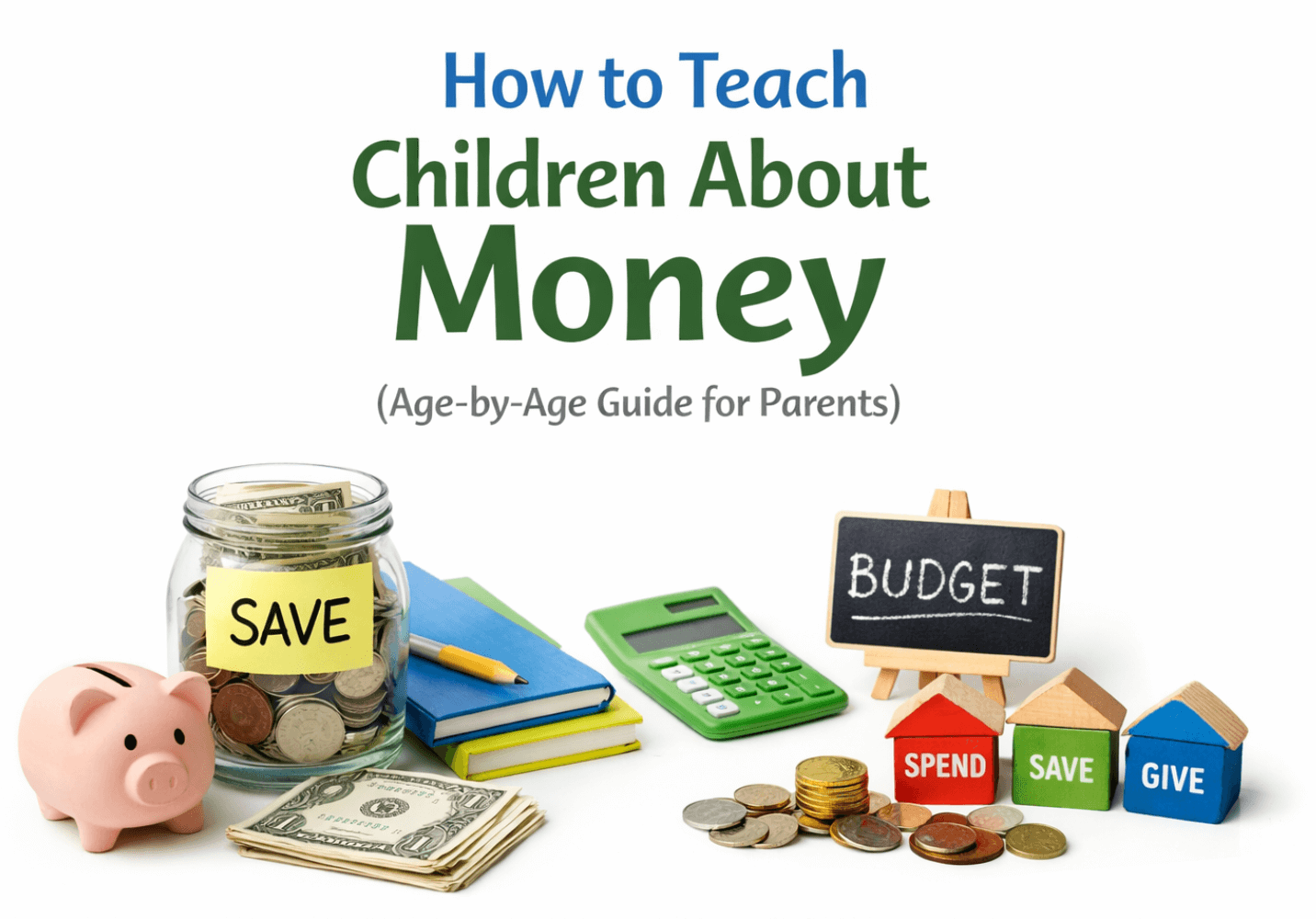
Raising Financially Confident Kids in a World That Doesn’t Teach This
Most parents say they want their children to “do better than they did.”
But here’s the uncomfortable truth:
That doesn’t happen by accident.
We don’t pass down wealth, confidence, or financial wisdom by hoping our kids “figure it out.” We pass it down by teaching intentionally, patiently, and consistently.
No one taught most of us about money.
We learned through stress, debt, mistakes, and late nights staring at numbers that didn’t add up.
This article exists so your children don’t have to.
Teaching children about money isn’t about raising mini-investors or obsessed savers. It’s about raising capable, confident adults who understand how money works, how to respect it, and how to use it as a tool, not a source of fear.
Let’s walk through how to do that, step by step.
Why Teaching Children About Money Early Matters
Money is one of the most powerful forces in adult life, yet one of the least explained during childhood.
By the time most people reach adulthood, they already have:
- Emotional reactions to money
- Spending habits they didn’t choose consciously
- Beliefs formed by observation, not education
Children absorb money behavior long before they understand money language.
They notice:
- Stress around bills
- Arguments about spending
- Silence when money comes up
- Guilt, fear, or secrecy
Teaching kids about money early does three things:
- It replaces confusion with clarity
- It replaces fear with confidence
- It replaces reactive behavior with intentional choice
This is not about numbers first.
It’s about mindset first.
At What Age Should You Start Teaching Kids About Money?
There is no “too early.”
You don’t start by explaining compound interest to a four-year-old.
You start by teaching cause and effect.
Money education grows with the child.
Think of it like language:
- You don’t wait until adulthood to teach words
- You speak simply, then build complexity
The biggest mistake parents make is waiting until:
- “They’re older.”
- “They understand math.”
- “School will teach them.”
School rarely teaches money well.
And when it does, it’s too late to shape habits.
Core Money Lessons Every Child Should Learn
Before age-based tactics, let’s talk principles.
Every child should eventually understand these fundamentals:
Money Is Earned
Money is connected to effort, skill, value, or contribution.
This teaches:
- Responsibility
- Appreciation
- Agency
Money Is Finite
When money is spent, it’s gone.
This introduces:
- Trade-offs
- Opportunity cost
- Decision-making
Money Has Options
Money can be:
- Spent
- Saved
- Shared
- Grown
This builds flexibility instead of rigid thinking.
Money Choices Have Consequences
Not punishment, feedback.
Good decisions create options.
Poor decisions limit them.
How to Teach Children About Money by Age
Ages 3–5: Introducing Money Basics
At this age, money is physical and visual.
What to focus on:
- Coins and bills
- Exchange (“we give money to get things”)
- Simple choices
Practical ideas:
- Let them hand money to the cashier
- Show them prices (without pressure)
- Use simple language: “We choose this instead of that.”
Avoid:
- Lectures
- Scarcity panic (“We can’t afford anything! ”)
- Emotional spending displays
Your goal here is familiarity, not mastery.
Ages 6–8: Building Simple Money Habits
This is the perfect time to introduce structure.
Allowance (optional but useful):
Not as entitlement, but as practice.
Rules that work:
- Tie allowance to responsibility, not obedience
- Let them manage it (with guidance)
- Don’t rescue every bad choice
Introduce:
- Saving jars or envelopes
- Short-term goals (“Save for this toy ”)
- Waiting before buying
This age is where patience begins to form.
Ages 9–12: Teaching Budgeting and Planning
Now kids can think ahead.
This is where money becomes strategic.
Key lessons:
- Planning before spending
- Saving for bigger goals
- Comparing options
What works well:
- Simple budgets (income → categories → choice)
- Letting them earn extra money through effort
- Talking through decisions instead of dictating them
This age is ideal for teaching:
“Just because you can buy something doesn’t mean you should.”
Ages 13–18: Preparing for Financial Independence
This stage matters more than most parents realize.
Your child is forming beliefs they’ll carry into adulthood.
Teach them:
- How bank accounts work
- What debit cards really represent
- Why debt is not “free money.”
- How income and expenses relate
Introduce the investing conceptually:
Not stocks and charts but ownership and growth.
Explain:
- Money can work for you
- Time is an advantage
- Small amounts matter when compounded
This is where financial confidence or fear is locked in.
Allowances: Should Kids Get Paid?
There’s no single right answer.
But here’s a grounded approach:
Allowance is a training tool, not a reward system.
Done right, allowance teaches:
- Planning
- Prioritization
- Consequences
What to avoid:
- Paying for basic family responsibilities
- Using money as emotional leverage
- Constantly increasing allowance without learning
Some families replace allowance with:
- Earned tasks
- Small projects
- Skill-based income
The method matters less than the conversation.
Teaching Kids to Save Money Without Making It Boring
Saving fails when it feels abstract.
Kids save best when:
- Goals are visible
- Progress is measurable
- The purpose is clear
Instead of saying:
“Save your money.”
Say:
“What are you saving for?”
Use:
- Clear containers
- Visual trackers
- Countdown goals
Saving is not about restriction.
It’s about future choice.
How to Teach Children About Spending Wisely
Spending is where real learning happens.
The goal is not to prevent mistakes. It’s to allow safe ones.
Teach kids to:
- Compare prices
- Ask, “Is this worth it?”
- Understand quality vs quantity
Let them experience:
- Buyer’s remorse (gently)
- The cost of impulse decisions
- The satisfaction of thoughtful purchases
Protection from all mistakes creates fragile adults.
Teaching Kids About Giving and Generosity
Money education without generosity creates an imbalance.
Giving teaches:
- Perspective
- Empathy
- Purpose
This isn’t about guilt or obligation.
It’s about showing kids that:
Money is a tool to create impact, not just comfort.
Let them choose:
- Causes
- People
- Situations
Giving builds emotional wealth alongside financial literacy.
Introducing Kids to Investing and Wealth Building
You don’t need to teach stock tickers.
You teach ownership thinking.
Explain:
- Owning vs consuming
- Long-term vs short-term thinking
- Growth through patience
Use examples:
- Businesses they recognize
- Real-world ownership
- Time as a multiplier
The goal is not technical mastery. Its identity:
“I am someone who builds, not just spends.”
Using Real Life as the Classroom
The best money lessons don’t come from worksheets.
They come from:
- Grocery shopping
- Family budgeting
- Vacation planning
- Mistakes and adjustments
Talk through decisions out loud.
Let your kids hear:
- Reasoning
- Trade-offs
- Priorities
Silence creates mystery.
Transparency creates understanding.
Common Mistakes Parents Make When Teaching Kids About Money
Avoiding the topic
Silence teaches avoidance.
Using fear
Fear creates anxiety, not wisdom.
Not modeling behavior
Kids believe what you do, not what you say.
You don’t need to be perfect.
You need to be honest.
How Teaching Children About Money Builds Generational Wealth
Generational wealth is not just about assets.
It’s:
- Knowledge
- Habits
- Confidence
- Values
Money can be lost.
Understanding lasts.
When children grow up knowing:
- How to earn
- How to manage
- How to grow
- How to give
They don’t just inherit wealth. They sustain it.
Final Thoughts: This Is a Long Game
Teaching children about money is not one conversation.
It’s hundreds of small moments.
You will:
- Get it wrong sometimes
- Learn alongside them
- Adjust as they grow
That’s okay.
The goal isn’t perfection.
It’s progress and presence.
Because one day, your children won’t just remember what you gave them.
They’ll remember what you taught them.
And that is the most valuable inheritance of all.
FAQ: How to Teach Children About Money
What is the best age to start teaching children about money?
The best age to start teaching children about money is as early as ages 3–5. At this stage, kids can learn simple concepts like exchanging money for goods, making choices, and understanding that money is limited. Financial education should grow gradually as the child matures, becoming more detailed over time.
How do I teach my child about money if I’m not good with money myself?
You don’t need to be perfect with money to teach your child. The most important thing is honesty and consistency.
Learn alongside your child, talk openly about decisions, and model progress rather than perfection. Teaching children about money is as much about mindset and values as it is about numbers.
Should children receive an allowance?
Children can receive an allowance, but it should be used as a learning tool, not an entitlement. Allowances work best when they help kids practice budgeting, saving, and decision-making.
Some parents prefer allowing kids to earn money through tasks or small projects, which can also teach responsibility and effort.
How much allowance should kids get?
There is no universal amount. A common guideline is a small weekly amount appropriate to the child’s age, enough to practice saving and spending without creating dependence. The focus should be on managing money wisely, not the amount itself.
How can I teach kids to save money?
Teaching kids to save money works best when savings are goal-based and visual. Help your child choose something meaningful to save for, track progress visually, and celebrate milestones. Saving should feel empowering, not restrictive.
How do I teach children the difference between needs and wants?
You can teach the difference between needs and wants by using real-life examples, such as grocery shopping or budgeting conversations.
Explain that needs are essentials like food and shelter, while wants are optional extras. Over time, kids learn to prioritize and make thoughtful choices.
Should kids learn about investing?
Yes, children should be introduced to investing concepts in an age-appropriate way. Start by explaining ownership, long-term thinking, and how money can grow over time.
You don’t need to teach stock picking. Focus on patience, compounding, and building assets instead of only spending.
How do I teach teens about money before adulthood?
For teenagers, focus on real-world skills like banking, budgeting, earning income, and understanding debt. This is also the ideal time to introduce basic investing concepts and discuss financial independence. Preparing teens financially reduces costly mistakes later in life.
What are the biggest mistakes parents make when teaching kids about money?
Common mistakes include avoiding money conversations, using fear or stress to talk about money, and failing to model healthy financial behavior.
Children learn most by observation, so transparency and calm discussions are more effective than lectures or secrecy.
How does teaching children about money help build generational wealth?
Teaching children about money builds generational wealth by passing down knowledge, habits, and values, not just assets.
Kids who understand money grow into adults who can manage, grow, and protect wealth, breaking negative financial cycles and sustaining prosperity across generations.
Can schools teach kids financial literacy, or is it a parent’s responsibility?
While some schools offer basic financial education, parents play the most important role. Children learn daily money habits at home through observation and conversation. Parental guidance fills the gap that formal education often leaves.