One of the most common questions I got asked when I speak with foreigners is that can a foregner create a company in Mexico?
The simple answer is yes, a foreigner can create or invest in a company in Mexico. In many ordinary business activities, foreign investment may own up to 100% of a Mexican company.
However, restricted or regulated sectors, immigration status, tax registration and foreign-investment reporting can change the answer.
Creating the legal entity is also only the beginning: the company still needs a tax identity, electronic signature, bank account, accounting system and any activity-specific permits.
My own experience was creating Hudson Digital Assets S.A.S. de C.V. in Mexico. I chose a simplified structure for a digital-asset business, but the process taught me something important: “online” does not mean effortless.
Your CURP, RFC, e.firma, address and names must match across government systems. After incorporation, SAT registration, proof of address and banking can become bigger roadblocks than the company-formation form itself.
This article gives you the full roadmap. It is educational, not individualized legal, tax or immigration advice.
Before choosing an entity or signing documents, speak with a Mexican corporate lawyer and a qualified Mexican accountant.
If you do not speak Spanish, bring a trusted Spanish-speaking person or hire bilingual professionals.
In practice, most SAT personnel communicate in Spanish and you should not expect an English-language appointment.

What is the best business structure I can create in Mexico?
For many small and medium foreign-owned businesses, the two structures worth discussing first with counsel are the Sociedad de Responsabilidad Limitada de Capital Variable, or S. de R.L. de C.V., and the Sociedad Anónima de Capital Variable, or S.A. de C.V.
A Sociedad por Acciones Simplificada, or S.A.S., can be attractive for a solo founder or very small team because it uses an electronic constitution process and does not ordinarily require a notary for formation.
But it has eligibility limits, standardized bylaws and an annual revenue ceiling. In 2026, the S.A.S. annual gross-income ceiling is MXN 7,678,849.94; if the company exceeds it, it must transform into another recognized company type.
Do not select a company solely because it is cheaper or faster to form. Choose it based on ownership, investor plans, liability, governance, tax treatment, expected revenue, banking needs and exit strategy.
Can foreigners own a company in Mexico?
Mexico generally allows foreign investment to participate in any proportion in the capital of a Mexican company unless the activity is reserved, capped or requires prior approval under the Foreign Investment Law.
Examples of sensitive areas include certain transport, broadcasting, financial, energy and other regulated activities.
A normal consulting, software, ecommerce, content, digital-marketing or export-services company is usually less complicated, but your lawyer should confirm the exact business purpose before incorporation.
Company ownership and permission to work are different questions. A person may be legally able to own shares yet still need the correct immigration authorization to perform paid work in Mexico.
Permanent residents generally have broader work rights, while temporary residents should confirm whether their status authorizes the planned activity. Ask an immigration lawyer or the Instituto Nacional de Migración about your specific status.
Mexico’s Foreign Investment Law treats investment by a foreigner who has permanent-resident status as Mexican investment for many purposes, subject to statutory exceptions.
That detail may affect whether a filing with the National Registry of Foreign Investments is required, so do not assume have counsel analyze the ownership and residency facts.
The main types of companies foreigners can create
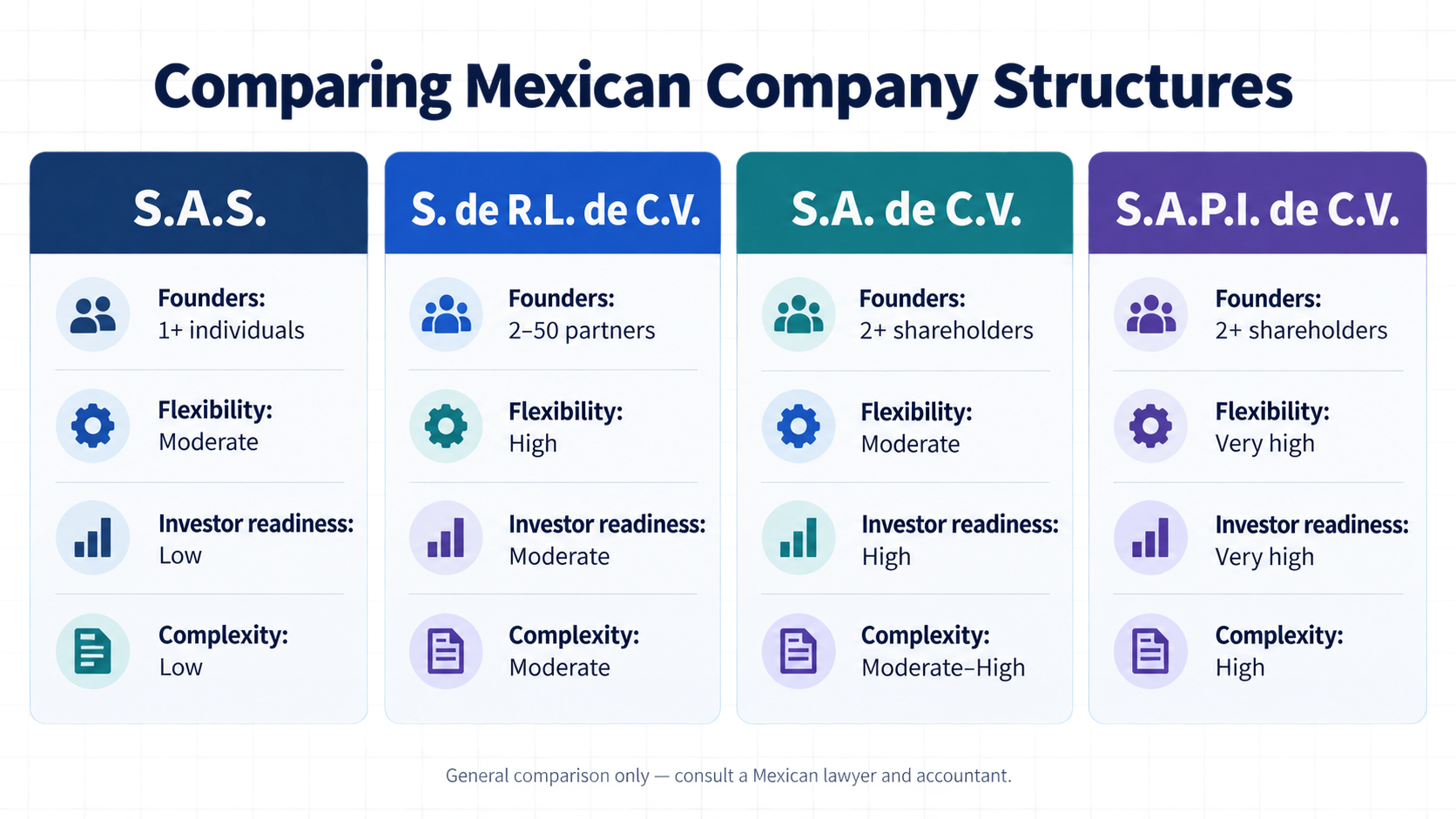
| Structure | Best suited to | Important points |
| S.A.S. / S.A.S. de C.V. | Solo founders and very small businesses that meet the electronic-system requirements | One or more individual shareholders; standardized online process; all shareholders need valid e.firma; 2026 revenue ceiling of MXN 7,678,849.94; transformation required if exceeded. |
| S. de R.L. de C.V. | Closely held businesses, partners, family companies and many foreign-owned SMEs | Usually 2 to 50 partners; ownership represented by membership interests rather than freely traded shares; flexible, private governance; commonly compared with an LLC, but foreign tax classification must be reviewed separately. |
| S.A. de C.V. | Businesses expecting more shareholders, formal corporate governance or outside investment | Normally at least two shareholders; shares, shareholder meetings and one or more administrators or a board; common and familiar to banks and investors. |
| S.A.P.I. de C.V. | Startups, venture-backed businesses and negotiated investor rights | More flexible shareholder arrangements, minority protections, vesting and exit provisions; higher legal cost and complexity. |
| Sociedad Civil / Asociación Civil | Professional practices or nonprofit/civil purposes, depending on the activity | Not a substitute for a commercial company. Purpose, member liability and tax treatment require careful review. |
| Branch of a foreign company | An established foreign corporation expanding directly into Mexico | The foreign parent remains involved; requires foreign-document legalization/apostille, translations and local registration; often heavier compliance than a Mexican subsidiary. |
Why I chose a S.A.S. for Hudson Digital Assets
For Hudson Digital Assets, the S.A.S. structure matched the early stage of the business: a focused digital business, simple ownership and no immediate need for sophisticated investor rights. The electronic formation route also reduced the cost and formality of creating the entity.
That does not make S.A.S. the best choice for every expat. If you plan to bring in investors, issue special economic rights, hold complex assets, exceed the annual revenue threshold or need customized governance, an S. de R.L., S.A. or S.A.P.I. may be a better foundation. I would treat the S.A.S. as a specific tool, not a default recommendation.
How to Create a Company in Mexico as a Foreigner
Step 1 Define the business before choosing the entity
Write down the real business before speaking to your lawyer and accountant. This prevents you from forming an entity whose corporate purpose, tax obligations or permits do not match what you actually do.
Exact products or services, including online and cross-border sales.
Who will own the company and in what percentages.
Whether any shareholder is a Mexican or foreign legal entity. A S.A.S. is limited to individual shareholders.
Expected revenue in years one to three and whether you could exceed the S.A.S. ceiling.
Whether you need employees, contractors, imports, exports, a physical location or regulated permits.
Whether you expect investors, bank financing, a future sale or a holding-company structure.
Where each owner is tax resident and whether another country will classify the Mexican entity differently.
Ask the accountant to model the company’s expected Mexican income tax, VAT, payroll and withholding obligations.
Ask the lawyer to confirm foreign-ownership limits, governance, contracts, intellectual property and immigration implications.
Step 2 Assemble the founder document file
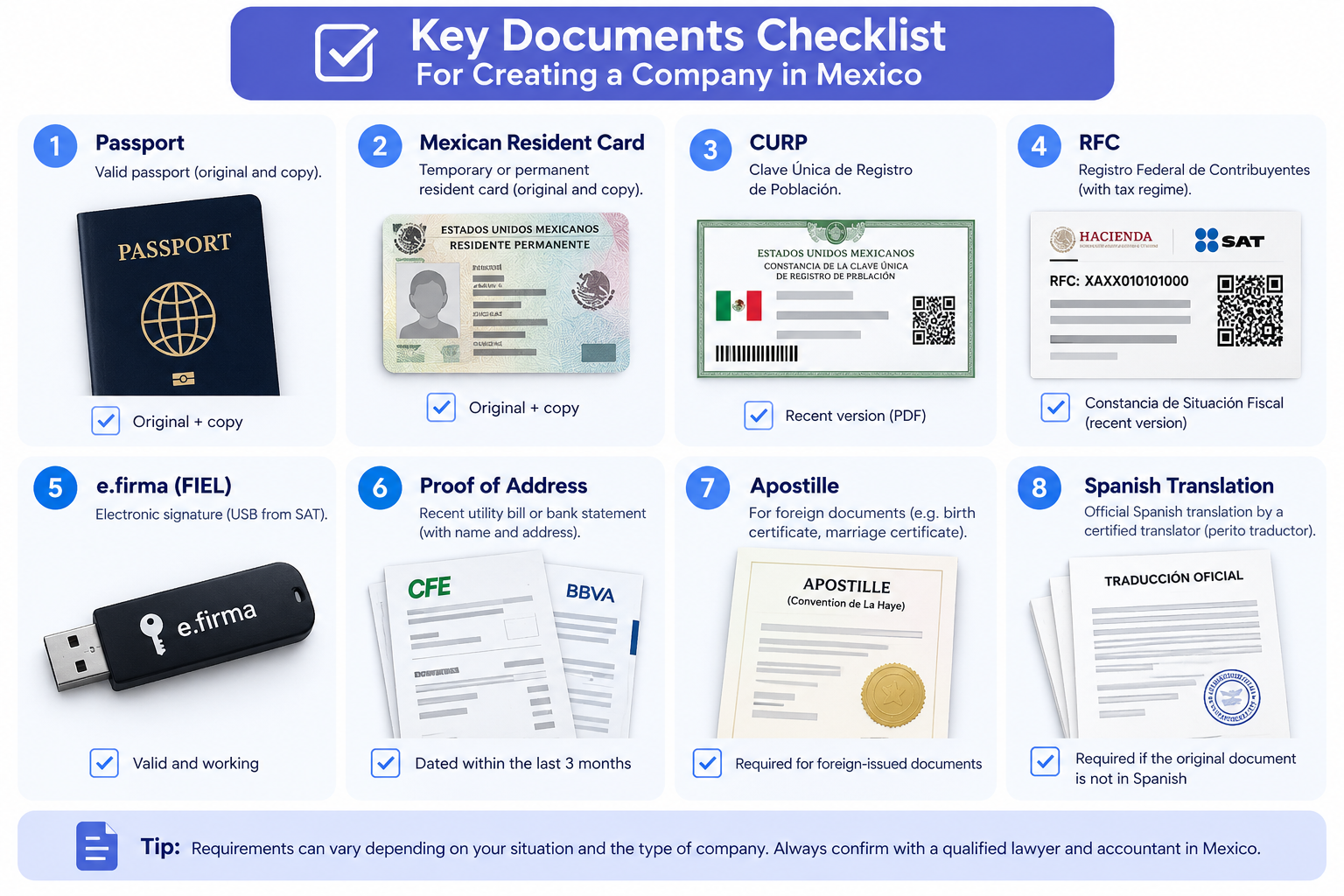
Exact requirements vary by entity, notary, SAT office, bank and whether documents were issued abroad. Prepare originals, clear copies and consistent digital scans. A common founder file includes:
Valid passport and, if applicable, Mexican resident card.
CURP and personal RFC for each shareholder or relevant Mexican representative.
Current Constancia de Situación Fiscal for persons already registered with SAT.
Valid personal e.firma files and password where the process requires electronic signatures. Never give unrestricted control of your e.firma to an untrusted intermediary.
Proof of home address and proof of the future company’s fiscal address in a format accepted by SAT.
Mexican telephone number and email address used consistently in registrations.
Marriage or civil-status documents if a professional says they affect ownership or marital-property questions.
For a foreign corporate shareholder: certified formation documents, certificate of good standing where required, bylaws, board resolutions, powers of attorney and ownership information.
Apostille or consular legalization for foreign public documents, as applicable.
Spanish translations by an authorized expert translator when documents are not in Spanish.
Beneficial-owner information and evidence showing who ultimately owns or controls the company.
The most common hidden problem is inconsistency: one system shows two surnames, another shows one; the passport includes a middle name; the CURP or RFC uses a different order; or the proof of address does not match the registered fiscal address. Resolve these mismatches before the appointment whenever possible.
Step 3 Check immigration and foreign-investment restrictions
Before committing money, have counsel confirm three things: whether your activity permits the intended level of foreign ownership; whether your immigration status permits the work you will personally perform; and whether the company must register with the National Registry of Foreign Investments, known as the RNIE.
Mexican companies with foreign investment generally must register with the RNIE within 40 business days of incorporation or the foreign investor’s entry into the capital. However, permanent-resident and statutory exceptions can affect the analysis.
The registry can also impose later notices and periodic economic reports depending on changes and financial thresholds.
Put the relevant filing dates on a compliance calendar instead of treating RNIE registration as a one-time task.
Step 4 Reserve the company name
Request an autorización de uso de denominación o razón social through the Ministry of Economy. Submit several distinctive alternatives because a name can be rejected for similarity, restricted words or conflicts.
Name authorization is not the same as trademark protection. If the brand matters, conduct a trademark search and discuss an IMPI application separately.
Practical tip
Make the legal name broad enough for the business to evolve, but keep the corporate purpose accurate. Your lawyer should draft or review both.
Banks, payment processors and commercial partners may compare the activity in the bylaws with your actual transactions.
Step 5 Draft and sign the formation documents
For an S.A.S.
The S.A.S. is formed through the Ministry of Economy’s electronic system. The law requires one or more individual shareholders, an approved name and a valid advanced electronic signature for every shareholder.
The system generates the social contract and sends the company for registration in the Public Registry of Commerce.
A notary is optional for the statutory S.A.S. formation process, although later acts or practical needs may still require professional or notarized documents.
The standardized process is convenient but offers less room to customize investor protections, deadlock clauses and sophisticated governance. Review every selection before signing; “standard” does not mean “appropriate for my business.”
For S. de R.L., S.A. and S.A.P.I.
Your lawyer and a Mexican notary or commercial broker normally prepare and formalize the constitutive deed.
The document covers the founders’ identities and nationalities, purpose, legal name, duration, capital, contributions, registered office, administration, powers, profit and loss allocation, dissolution and liquidation rules.
It should also contain the appropriate foreign-admission or exclusion clause.
Do not sign a generic deed you do not understand. Ask for an English explanation or bilingual summary, but remember that the Spanish legal instrument controls.
Confirm who can open bank accounts, sign contracts, hire personnel, borrow, sell assets and delegate powers.
Step 6 Register the company in the Public Registry of Commerce
Registration gives the company’s formation public effect. For a conventional company, the notary or broker usually handles the filing.
For an S.A.S., the electronic system generates the registration process. Keep the registered deed or social contract and the boleta de inscripción. You will need them for SAT, banking and many commercial procedures.
Step 7 Register the company with SAT and obtain the RFC
The company needs its own RFC. Do not confuse it with the shareholder’s personal RFC. Conventional companies may be enrolled through an eligible notary at signing or by the legal representative at a SAT office.
SAT’s 2026 rules also provide a specific in-office procedure for an S.A.S., generally within one month after signing the social contract.
For a conventional legal entity, the SAT file commonly includes:
SAT appointment.
Certified, protocolized constitutive document.
A valid RFC for each partner, shareholder and other member of the legal structure, stated in the deed or in the permitted written declaration.
An .xlsx relationship containing RFC, CURP for individuals, and full legal names of the relevant owners or members.
Original proof of fiscal address.
Certified instrument proving the representative’s authority, or an accepted power of attorney.
Valid original identification for the representative.
For powers granted abroad: apostille or legalization, formalization before a Mexican notary where required, and an authorized Spanish translation.
For foreign owners who are not required to obtain an RFC, the information and generic foreign RFC treatment required by SAT.
For an S.A.S., SAT’s 2026 checklist includes the social contract issued by the Ministry of Economy, the Public Registry of Commerce registration slip, the shareholder spreadsheet, proof of address, identification and evidence of representation.
Shareholders and the representative must generally be active in the RFC and have valid e.firma credentials for the applicable process.
Reality check
Take originals, copies, the appointment confirmation and a USB drive. Ask your accountant to review the complete folder before you go.
Arrive early and expect the appointment to be conducted in Spanish. If you cannot confidently explain the activity, address, ownership and representation, take a Spanish-speaking adviser or trusted interpreter.
Step 8 Obtain the company e.firma and digital seal certificate
The company’s e.firma is distinct from the individual founder’s e.firma. The legal representative completes the SAT process with the company documents, identification, authority and a USB drive. Afterward, the company normally needs a Certificado de Sello Digital to issue CFDI electronic invoices.
Store the .cer and .key files securely, protect passwords, restrict access and document who can use them. These credentials can create serious tax and legal consequences if misused.
Step 9 Confirm the tax regime and activate compliance
Have the accountant verify the obligations shown in the company’s Constancia de Situación Fiscal.
A Mexican company may have monthly, annual and informational returns, VAT, income-tax payments, withholding obligations, electronic accounting and CFDI requirements.
The exact obligations depend on activity, customers, payroll, cross-border payments and tax regime.
Important questions include whether the company qualifies for RESICO for legal entities, how foreign-source or export services are treated, whether VAT is charged or zero-rated, whether payments to nonresidents require withholding, and whether related-party or transfer-pricing rules apply. Do not copy another entrepreneur’s tax setup.
Engage the accountant before the first invoice or expense.
Select compliant invoicing and accounting software.
Enable and monitor the Buzón Tributario and registered contact channels.
Create a monthly closing process and preserve XML invoices, contracts, bank records and support for deductions.
Document the controlling-beneficiary information required by Mexican tax rules and keep it current.
Step 10 Register foreign investment when required
If the company has reportable foreign investment, complete RNIE registration within the applicable deadline, generally 40 business days and identify subsequent notices or reports.
The filing needs corporate, representative, owner, nationality, residency, capital, activity and investment information. Late or incomplete compliance can create fines and due-diligence problems later.
Step 11 Open the corporate bank account
A bank account is not automatically opened because the company exists. Mexican banks conduct their own know-your-customer and anti-money-laundering review, and requirements vary by institution and branch.
Constitutive deed or S.A.S. contract and Public Registry evidence.
Company RFC and Constancia de Situación Fiscal.
Company e.firma or other tax credentials requested by the bank.
Proof of the company’s address, sometimes in the company name.
Identification, CURP, RFC and immigration document of the representative and owners.
Powers granting the representative authority to open and operate accounts.
Beneficial-owner declaration, ownership chart and source-of-funds information.
Expected activity, customers, countries, transaction volume and contracts or invoices.
Initial deposit and, depending on the bank, a branch visit by signatories.
This is a frequent expat roadblock. A bank may reject an otherwise valid proof of address, ask for a document in the exact corporate name, request additional evidence for foreign owners, or interpret powers narrowly.
Ask the bank for its current checklist in writing before the appointment, and have the notary confirm that the deed grants the required banking powers.
Step 12 Complete registrations and permits for your activity
The remaining registrations depend on what the company does and where it operates. Your lawyer and accountant should build a tailored compliance map that may include:
Municipal or state operating license, land-use approval, civil-protection filing and signage permit.
IMSS employer registration, payroll tax, INFONAVIT and employment documentation if you hire workers.
Importer registry, customs broker arrangements, NOM compliance or sector permits for goods.
Health, environmental, telecom, financial, transport, energy or other regulated approvals.
Privacy notice and personal-data procedures under Mexican law.
Consumer terms, ecommerce disclosures and PROFECO-related obligations.
IMPI trademark registration and assignment of intellectual property created by founders, employees or contractors.
The biggest roadblocks foreigners face
| Roadblock | Why it happens | How to reduce the risk |
| CURP, RFC or name mismatch | Government systems may hold different versions of a foreign name. | Compare passport, resident card, CURP, RFC and e.firma before formation; correct discrepancies early. |
| No valid personal e.firma | S.A.S. formation and later tax procedures depend on valid credentials. | Obtain or renew it first; verify the files and password before starting. |
| Proof of address rejected | SAT and banks accept specific documents and may expect an exact name/address match. | Use the current official checklist; bring originals and alternatives; confirm whether the document may be in the landlord’s or another person’s name. |
| Foreign documents not usable | A foreign power or corporate record may lack apostille/legalization or an accepted translation. | Ask the Mexican notary for the exact document form before ordering or shipping originals. |
| S.A.S. platform incompatibility | The online flow relies on active RFC, CURP and e.firma records and standardized data. | Test eligibility first; use S. de R.L. or S.A. if ownership or documents do not fit. |
| Wrong corporate purpose or powers | Generic wording may not support banking, permits or actual services. | Have a corporate lawyer draft and have the bank-power language reviewed. |
| Bank account delays | Each bank has separate KYC standards and foreign-owner scrutiny. | Pre-clear the file with the chosen branch and prepare an ownership chart and business evidence. |
| Missing RNIE or ongoing filings | Owners focus on formation and overlook post-formation deadlines. | Create a lawyer-accountant compliance calendar immediately. |
| Language barrier | Official processes and appointments are usually conducted in Spanish. | Use bilingual counsel and an accountant, or bring a trusted Spanish speaker; do not sign what you do not understand. |
How long does it take and how much does it cost
There is no reliable universal price or timeline. An uncomplicated S.A.S. can be formed electronically with no notarial formation fee, but you can still incur legal, accounting, translation, apostille, address, banking and permit costs.
A notarized S. de R.L., S.A. or S.A.P.I. usually costs more and can take several weeks, particularly when foreign documents or tailored bylaws are involved.
Ask for a written scope that separates: name authorization; legal drafting; notary and registry fees; apostilles and translation; SAT registration and e.firma; RNIE work; bank-account support; permits; monthly accounting; payroll; and annual corporate maintenance.
A very low formation quote may omit the steps that actually make the company operational.
My practical advice after forming Hudson Digital Assets S.A.S. de C.V.
Start with the lawyer and accountant, not with the government portal.
Choose the structure for the business you expect in two or three years, not only for today.
Resolve CURP, RFC, e.firma and proof-of-address issues before incorporation.
Keep a physical folder and an encrypted digital folder with every signed document and acknowledgement.
Use one exact spelling of every name and address across systems.
Do not rely on English at SAT. Bring a capable Spanish speaker if necessary.
Open the bank-account conversation early and ask which powers and address evidence the bank wants.
Track corporate, tax, foreign-investment, payroll and permit deadlines in one calendar.
Never treat a company as a substitute for immigration, tax or asset-protection advice.

Complete company formation checklist
Define activities, ownership, expected revenue and hiring plans.
Consult a Mexican corporate lawyer and Mexican accountant.
Confirm foreign-investment and immigration rules.
Choose S.A.S., S. de R.L., S.A., S.A.P.I. or another appropriate structure.
Prepare passport, residency, CURP, RFC, e.firma, address and foreign documents.
Obtain company-name authorization.
Draft, review and sign formation documents.
Register in the Public Registry of Commerce.
Obtain the company RFC.
Obtain the company e.firma and digital seal certificate.
Confirm tax obligations and invoicing setup.
Register with RNIE if required.
Open the corporate bank account.
Complete IMSS, payroll, local and sector registrations.
Protect the trademark, contracts, data and intellectual property.
Maintain books, ownership records, minutes, annual filings and compliance calendar.
Frequently asked questions
Can a foreigner own 100 percent of a Mexican company
Often yes, for activities that are not reserved, capped or subject to approval under the Foreign Investment Law. Your lawyer must check the exact corporate purpose and sector.
Do I need a Mexican partner
Not for many ordinary business activities. You should not add a nominee partner merely to simplify paperwork. Ownership must reflect the real arrangement and beneficial owners must be documented.
Can a foreigner create an S.A.S. in Mexico
Yes, a foreigner can create an S.A.S in Mexico, I created one.
The commercial law defines S.A.S. shareholders as individual persons and requires every shareholder to have a valid advanced electronic signature.
In practice, the electronic and SAT processes also depend on Mexican identity and tax records such as CURP and RFC.
A foreign individual who has the required Mexican records and valid e.firma may be able to use the route; a nonresident without them will usually find a notarized entity more practical. Confirm current system eligibility with counsel before relying on S.A.S.
Do I need a notary
S. de R.L., S.A., S.A.P.I. and most conventional companies are formed before a Mexican notary or commercial broker.
The statutory S.A.S. electronic process does not require a public deed, although later transactions or practical requirements may involve a notary.
Does creating a company give me residency or permission to work
No. Company ownership and immigration authorization are separate. Confirm your right to conduct the planned work with an immigration professional.
Can I complete the entire process in English
You should not plan on it. Corporate instruments, portals, tax records and most SAT interactions are in Spanish.
Use a bilingual lawyer and accountant, and take a trusted Spanish-speaking person to appointments if you are not fluent.
What happens if my S.A.S. exceeds the revenue ceiling
It must transform into another company type under the law. Failure to transform can expose shareholders to broader responsibility toward third parties. Monitor revenue with your accountant well before reaching the limit.
Is the company name automatically protected as a trademark
No. Authorization of a corporate name and trademark registration are different. Discuss a search and IMPI application if the brand has value.
Final word
Creating a company in Mexico is manageable when you treat it as a coordinated legal, tax, immigration and banking project.
The formation certificate is only one milestone. The company becomes truly usable when its RFC, e.firma, invoicing, accounting, bank account, foreign-investment obligations and operating permits are all aligned.
My experience with Hudson Digital Assets S.A.S. de C.V. showed me the value of preparation. The fastest way to lose time is to arrive with a mismatched name, unacceptable proof of address, expired e.firma or missing power.
The safest route is to have a Mexican lawyer design the structure, a Mexican accountant confirm the tax setup, and a Spanish-speaking person beside you whenever language could lead to a costly misunderstanding.
Want a clearer starting point for building wealth while living in Mexico or Colombia? Get the free Expat Wealth Starter Kit.