Most people believe they have a money problem.
What they actually have is a definition problem.
They confuse income with wealth, and that single misunderstanding quietly shapes every financial decision they make for decades. It determines what they chase, what they tolerate, and what they pass on to their children.
I’ve met people earning more in a month than others earn in a year, yet living paycheck to paycheck.
And I’ve met people with modest incomes who sleep well, move freely, and never panic when life changes.
The difference isn’t luck.
It isn’t intelligence.
It isn’t even discipline.
It’s understanding the difference between wealth and income and acting on it early enough.
This article exists to draw a clear line between the two, explain why society deliberately blurs that line, and show you how to shift from income thinking to wealth thinking before it’s too late.
What Income Really Is
Income is money you receive.
That’s it.
It can come from a salary, freelance work, commissions, business revenue, or side hustles. Income is active by nature. You do something, and you get paid.
Income is necessary. Income pays bills. Income keeps the lights on.
But income has three brutal limitations most people never confront:
- Income usually stops when you stop
- Income is taxed immediately
- Income is fragile
If you don’t show up, the money slows down or disappears. If you lose your job, get sick, burn out, or age out, income doesn’t care. It simply ends.
Income is movement. It flows through you, not to you.
And that’s where most people get trapped.
What Wealth Really Is
Wealth is what remains when income stops.
Wealth is not about how much you make this month.
It’s about how long you can live without making anything new.
Wealth is stored time, stored effort, and stored leverage.
It shows up as
- Assets that produce cash flow
- Ownership stakes
- Systems that work without your presence
- Capital that compounds
- Control over decisions, time, and risk
Wealth is quiet.
It doesn’t announce itself on social media.
It doesn’t need validation.
Wealth doesn’t rush because it doesn’t have to.
Why Income and Wealth Are Constantly Confused
The confusion isn’t accidental.
From childhood, we are trained to ask:
- “What do you want to be when you grow up?”
- “How much does that job pay?”
- “Is it a stable career?”
Notice what’s missing.
No one asks:
- “What do you want to own?”
- “What systems will support you when you’re 60?”
- “How long could your family survive without your labor?”
The education system rewards income. Employers reward income. Banks lend based on income.
So people optimize their entire lives around earning more without ever building anything that lasts.
Wealth vs Income: A Side-by-Side Reality Check
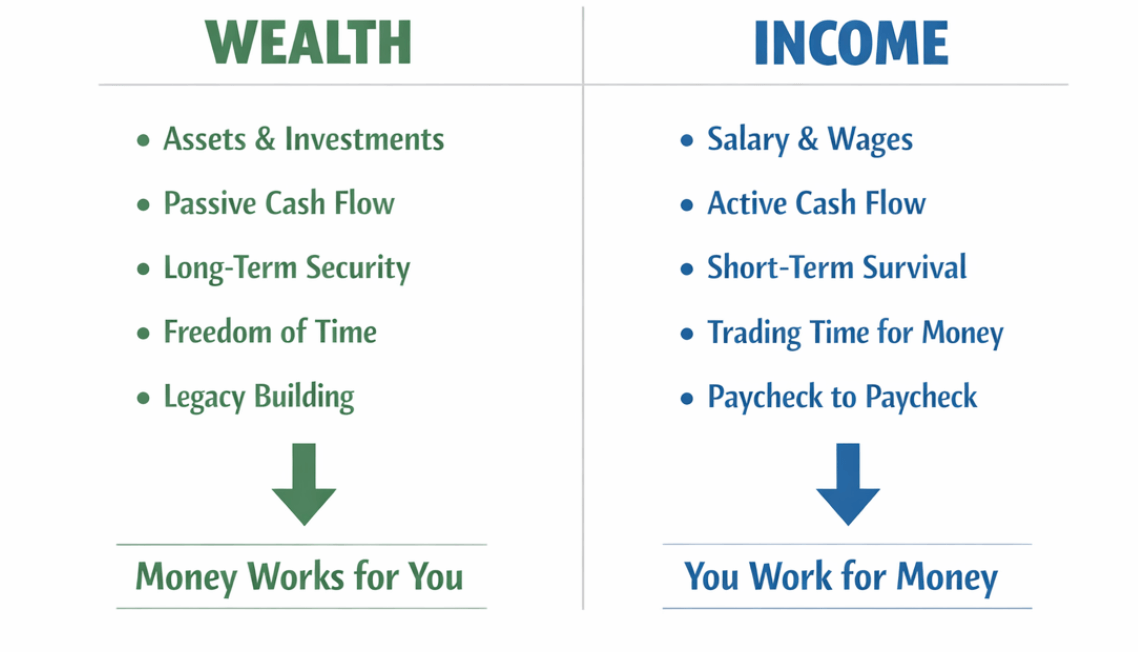
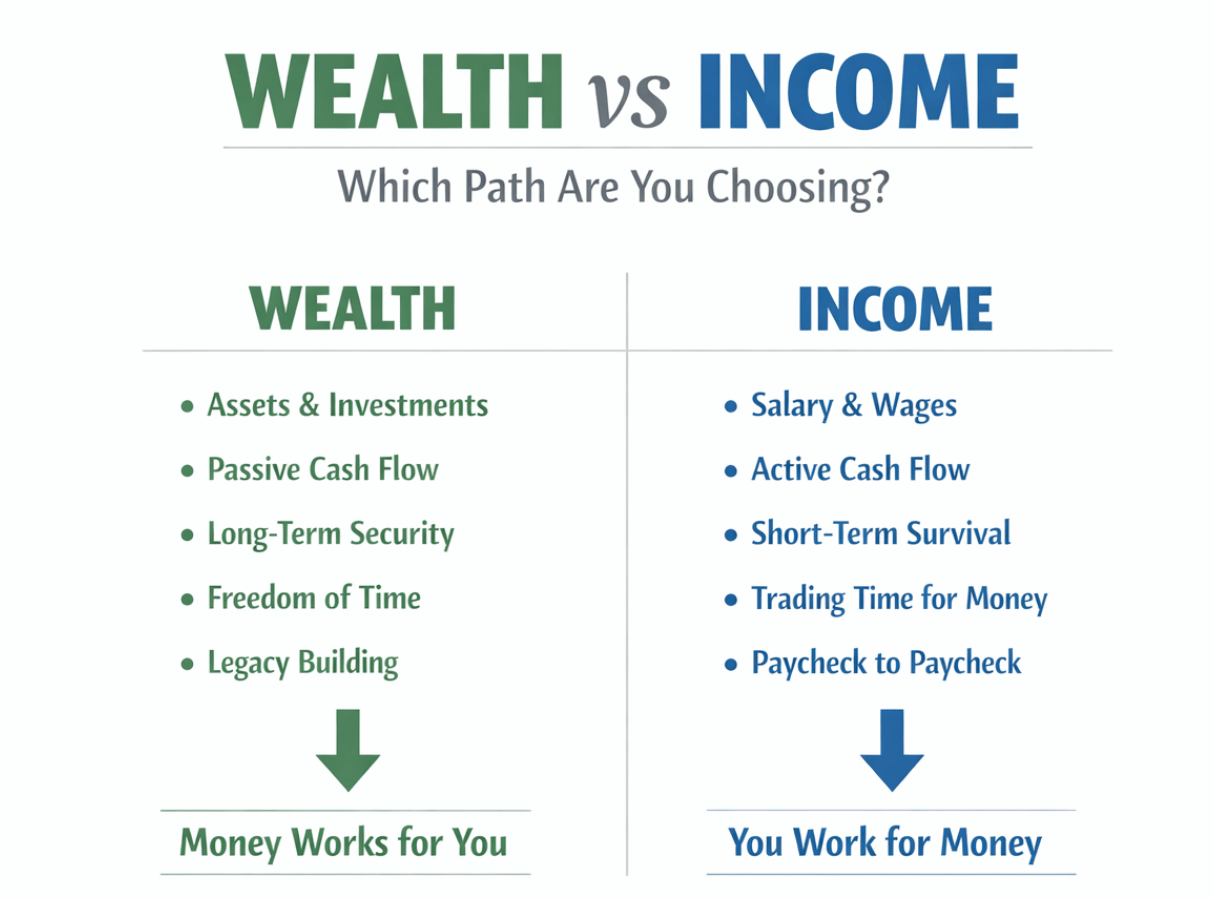
Here’s the simplest way to think about it:
- Income is effort-based
- Wealth is leverage-based
Income requires your participation.
Wealth requires your foresight.
Income is short-term survival.
Wealth is long-term independence.
You can earn a high income and still be financially fragile.
You can earn a modest income and still become wealthy over time.
Most people never stop to ask which game they’re playing.
The Six-Figure Trap
One of the most dangerous financial milestones is crossing into a high income.
Why?
Because income creates the illusion of wealth.
More money comes in, so lifestyle expands. Bigger house. Nicer car. Better vacations. Subscriptions everywhere. Fixed expenses rise quietly.
From the outside, it looks like success.
From the inside, it’s a tighter cage.
The higher the income, the harder it becomes to step away because everything now depends on maintaining that income.
This is how people earning six figures end up more stressed, more indebted, and more trapped than those earning half as much.
They don’t own their income.
Their income owns them.
Lifestyle Inflation: The Silent Wealth Killer
Lifestyle inflation is not a spending problem.
It’s a thinking problem.
When income rises, most people upgrade their consumption before upgrading their assets. They reward themselves immediately instead of permanently.
They treat extra income as permission, not opportunity.
And once a lifestyle expands, it rarely contracts willingly.
This is why income alone never creates wealth. Without intentional redirection, income simply passes through your hands and disappears.
Why Society Teaches Income but Not Wealth
There’s a reason wealth education is rare.
A population dependent on income is
- Predictable
- Compliant
- Easy to lend to
- Easy to tax
- Easy to control
Income-dependent people must show up every day. They cannot pause. They cannot think long-term. They cannot take risks.
Wealth creates optionality, and optionality weakens systems that rely on participation.
So the message stays the same:
Work harder. Earn more. Repeat.
No one tells you the game ends when you stop playing.
How the Wealthy Actually Think About Income
Wealthy people don’t hate income.
They just don’t worship it.
They see income as fuel, not the destination.
Income is something to be:
- Captured
- Controlled
- Converted
The goal is not to earn forever but to turn income into assets that eventually replace it.
Income is the seed.
Wealth is the tree.
Assets: The Bridge Between Income and Wealth
An asset is anything that puts money, value, or leverage into your life without requiring your presence every time.
Not everything called an “asset” actually is one.
True assets have at least one of these qualities:
- Produce cash flow
- Appreciate overtime.
- Reduce future expenses
- Increase control or optionality
Assets are slow at first. They feel unrewarded early on. That’s why most people abandon them.
But once assets reach critical mass, the curve bends and the game changes.
Why Assets Work While You Sleep
Time is the most underappreciated wealth multiplier.
Income resets every day.
Assets compound across years.
An asset built today doesn’t forget tomorrow. It doesn’t get tired. It doesn’t negotiate for a raise. It simply continues.
This is why wealth feels unfair to those who never build assets.
They only see the outcome, never the years of quiet accumulation that made it possible.
Wealth Is About Control, Not Just Ownership
Here’s something rarely discussed:
Wealth is less about owning things and more about controlling outcomes.
Control over:
- Cash flow
- Time
- Decisions
- Risk exposure
You can “own” many things and still have no control if they require constant maintenance, debt, or attention.
Real wealth increases your ability to say:
- No
- Not yet
- On my terms
Income alone rarely does that.
The Wealth Formula Most People Never Learn
Here’s the framework I live by:
Income → Margin → Assets → Compounding → Freedom
Most people stop at income.
Some save but never invest meaningfully.
Others invest inconsistently, emotionally, or too late.
The missing piece is margin, the intentional gap between what you earn and what you consume.
Without margin, wealth is mathematically impossible.
Why Saving Alone Will Never Make You Wealthy
Saving protects you from emergencies.
It does not create independence.
Savings sit still. Wealth moves.
At some point, money must be put to work in ownership, systems, investments, businesses, or productive assets.
Fear keeps people saving forever.
Wealth requires calculated exposure.
Where Income Still Matters
Income is not the enemy.
It’s the engine.
Especially early on, income is what allows you to:
- Learn
- Experiment
- Invest
- Make mistakes safely
The mistake is staying in income mode forever.
At some point, income must transition from supporting life to building leverage.
Generational Wealth vs Generational Income
Jobs die with you.
Assets don’t.
This is the clearest line between income and wealth.
Income supports one lifetime.
Wealth supports many.
If your children must start from zero despite your lifetime of work, then income was won, and wealth never entered the picture.
The Myths That Keep People Stuck
“If I earn more, I’ll be wealthy.”
No, if you convert more, you might be.
“Wealth is for the lucky or privileged.”
Luck accelerates. Structure sustains.
“Investing is riskier than working.”
Relying on one income source is the riskiest position of all.
Shifting From Income Thinking to Wealth Thinking
This shift is internal before it’s external.
Start asking different questions:
- How long could I live without working?
- What do I own that produces value?
- Where does my income go first?
- What am I building that outlasts me?
Track net worth, not just income.
Reward asset growth, not consumption.
Design your life around freedom, not paychecks.
Real-World Contrast
One person earns $150,000 a year, spends $145,000, owns nothing productive, and panics when work slows.
Another earns $60,000, saves aggressively, invests consistently, and builds assets over 20 years.
Who is wealthier?
Not today.
But eventually, without question.
FAQ: The Difference Between Wealth and Income
What is the difference between wealth and income?
Income is the money you earn from work or business activity. Wealth is the accumulation of assets, investments, and systems that continue to provide value and cash flow even when you stop working. Income is temporary; wealth is lasting.
Can you have a high income and still not be wealthy?
Yes, and this is extremely common. Many high earners live paycheck to paycheck due to lifestyle inflation, debt, and lack of asset ownership. Without converting income into assets, high income alone does not create wealth.
Is wealth better than income?
Wealth is not “better,” but it is more powerful. Income helps you survive month to month. Wealth gives you control, freedom, and long-term security. The goal is not to eliminate income, but to use income to build wealth.
Why do so many people confuse wealth with income?
Because society rewards income visibly, titles, salaries, promotions, while wealth is often invisible. Schools teach careers, not ownership. As a result, most people optimize for earning instead of building assets.
What are examples of wealth-building assets?
Wealth building assets include
- Income-producing businesses
- Real estate
- Stocks and index funds
- Digital assets (websites, intellectual property)
- Ownership stakes in companies
The key trait is that these assets work without requiring your constant presence.
Does saving money count as building wealth?
Saving is important, but saving alone does not create wealth. Savings protect you from emergencies. Wealth is built when money is invested into assets that grow, compound, or produce income over time.
How does income fit into a wealth-building strategy?
Income is the engine that funds wealth creation. Early on, your focus should be on increasing income and controlling expenses to create margin. That margin is then redirected into assets that eventually replace your income.
What is generational wealth, and how is it different from income?
Income supports one generation, you. Generational wealth consists of assets, systems, and knowledge that continue benefiting your family long after you’re gone. Jobs end. Assets persist.
Is it possible to build wealth with an average income?
Yes. Wealth is built through consistency, time, and asset ownership, not income level alone. Many people with average incomes become wealthy by investing early, living below their means, and letting compounding do the heavy lifting.
What is the first step to shifting from income thinking to wealth thinking?
Start tracking net worth instead of just income. Then ask one powerful question:
“Where does my income go, first consumption or asset building?”
That single shift changes everything.
Final Thoughts: Income Pays Bills, Wealth Buys Freedom
Income is necessary.
But it’s not the goal.
If you remember one thing from this article, let it be this:
Income is what you earn.
Wealth is what you keep, grow, and control.
Most people spend their entire lives improving their income while neglecting the only thing that actually changes outcomes.
Wealth is not built in public.
It’s built quietly, patiently, deliberately.
And once you see the difference, you can never unsee it.
That’s when everything changes.