
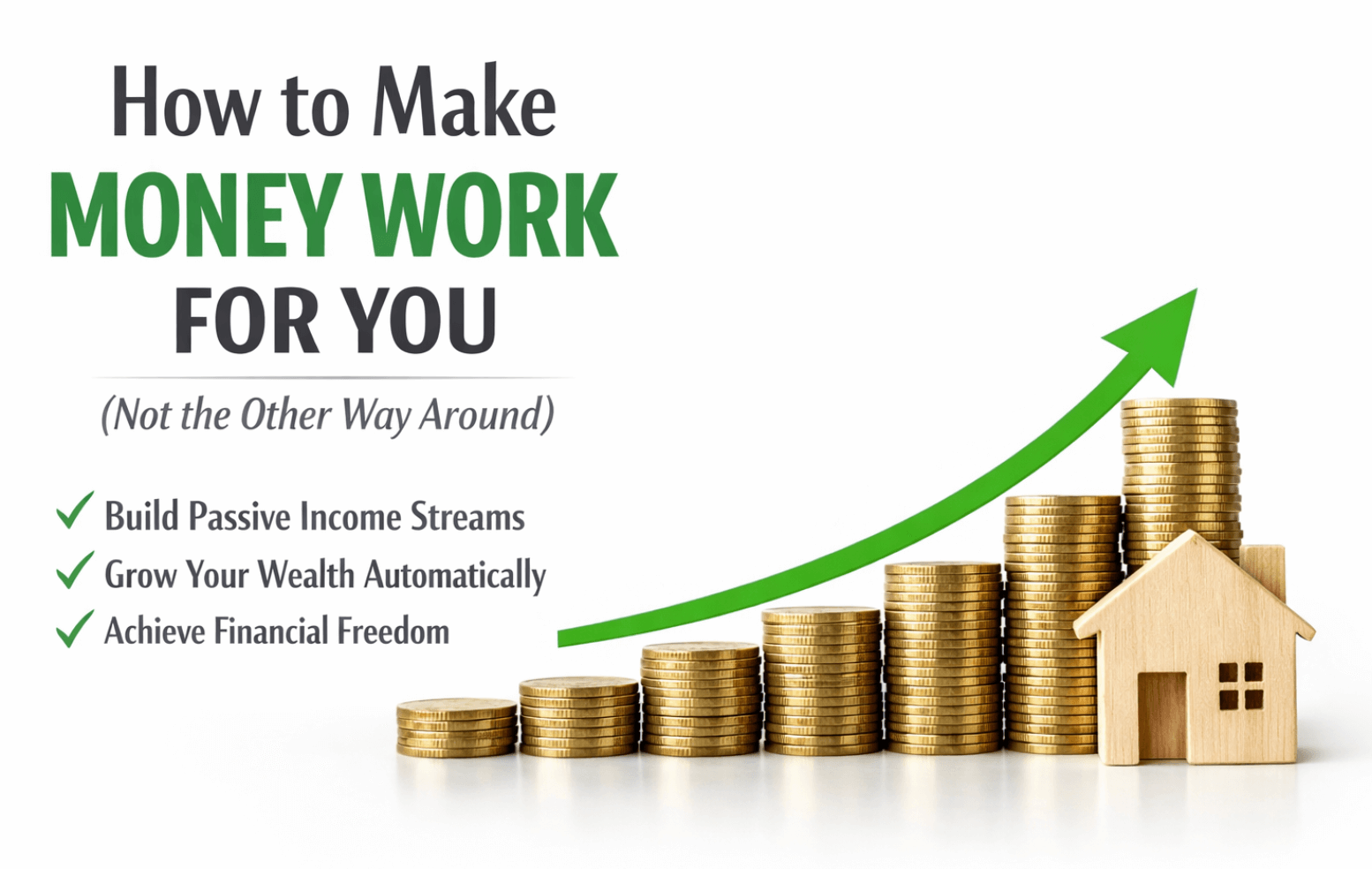
For the majority of my life, I adhered to the same narrative that nearly everyone learns.
Go to school.
Get a job.
Work hard.
Save what you can.
Hope everything works out.
And for a long time, I did exactly that.
I worked for money.
Every hour had a price. Every paycheck had a limit. Every missed day meant less income. No matter how disciplined I was, money always felt like something I had to chase.
Until I realized something that changed everything:
The wealthy don’t work harder for money. They build systems where money works for them.
That’s what this article is about.
Not get-rich-quick schemes.
Not passive income fantasies.
This isn’t simply financial advice masquerading as motivation.
This is about flipping the equation, so instead of spending your life working for money, you gradually build a life where money works for you.
What Does It Mean to Make Money Work for You?
Making money work for you doesn’t mean you never work again.
This means that your income is no longer restricted by the amount of time you have available.
When money works for you:
- It earns more money while you sleep
- It grows without constant effort
- It compounds year after year
- It creates options, not pressure
The opposite is working for money:
- Trading hours for dollars
- Hitting an income ceiling
- Starting from zero every month
- Living one paycheck away from stress
Most people never escape the first model, not because they’re lazy, but because they were never taught the second one exists.
Active Income vs Passive Income (The Real Difference)
Let’s clear up a common misunderstanding.
Passive income is “no work income.”
There is always work, especially at the beginning.
The difference is between when you work and how often you get paid for it.
- Active income pays you once
- Leveraged income pays you repeatedly
A job pays you for showing up today.
An asset pays you because you built it yesterday.
That distinction alone explains why some people get richer over time while others stay stuck, even with excellent salaries.
Why Working Hard Alone Will Never Make You Wealthy
Hard work is important. Discipline matters. But effort alone does not build wealth.
Here’s why.
Time Is Finite
There are only 24 hours in a day.
You can’t work 40 hours forever. You can’t double your time. And eventually, your energy declines—whether you want it to or not.
Income Has a Ceiling
Most jobs cap your earning potential.
Raises are incremental. Promotions are limited. And switching jobs often just resets the same cycle at a slightly higher level.
Inflation Is Always Working Against You
Even if your income grows, inflation silently reduces your purchasing power.
Money that sits still loses value. Money that works grows.
Saving Alone Won’t Save You
Saving is defensive. Investing is offensive.
You don’t build wealth by avoiding risk. You build it by owning productive assets.
The Core Principle: Money Should Buy Assets, Not Liabilities
This is where most people go wrong.
They earn money… then immediately spend it on things that cost more money.
Cars. Gadgets. Status purchases. Lifestyle upgrades.
None of those things produces income.
The wealthy do something different:
They convert income into assets.
What Is an Asset?
An asset is something that:
- Generates income
- Grows in value
- Or both
Examples include:
- Investments
- Businesses
- Cash-flow systems
- Intellectual property
- Ownership stakes
What Is a Liability?
A liability is something that
- Costs money to maintain
- Loses value over time
- Produces no income
The mistake isn’t owning liabilities.
The mistake is prioritizing them before building assets.
The Three Stages of Making Money Work for You
I’ve seen this pattern repeat across countries, industries, and income levels.
Wealth builders move through three clear stages.
Stage 1: Stabilize Your Finances
Before money can work for you, it needs structure.
This stage is not exciting, but it’s essential.
It includes:
- Understanding where your money goes
- Creating a margin between income and expenses
- Building an emergency buffer
- Reducing destructive debt
You can’t invest in chaos.
Stage 2: Invest for Long-Term Growth
Once you have stability, the focus shifts to compounding.
This is where money starts doing real work.
Long-term investing works because:
- Time multiplies returns
- Emotions are minimized
- Consistency beats brilliance
This stage rewards patience, not intelligence.
Stage 3: Build Income-Producing Systems
This is where freedom begins.
Here’s your money:
- Funds businesses
- Buys systems
- Supports cash-flow assets
Work becomes optional, not mandatory.
That’s the goal.
The Best Ways to Make Money Work for You
There’s no single path. But there are proven categories.
Investing in Stocks and ETFs
This is one of the simplest ways to put money to work.
Not by trading. Not by guessing.
By owning pieces of productive companies and letting time do the heavy lifting.
Index investing works because:
- It removes emotion
- It reduces fees
- It benefits from global growth
You don’t need to be brilliant. You need to be consistent.
Real Estate and Rental Income
Real estate works when numbers make sense.
It offers:
- Cash flow
- Appreciation
- Inflation protection
For beginners, indirect exposure (like REITs) can reduce complexity while still providing income.
Business Ownership
Businesses are leverage machines.
They allow you to:
- Separate income from hours
- Scale beyond personal effort
- Build transferable value
Digital businesses are especially powerful because:
- They scale globally
- They have low marginal costs
- They can run systems.
Online Income and Content Assets
Content, once created, can work for years.
Blogs, videos, newsletters, and digital products become intellectual assets.
They reward:
- Consistency
- Long-term thinking
- Systems over hustle
This is one of the most misunderstood but powerful wealth paths today.
Building Systems That Make Money Work Automatically
The difference between income and wealth is systemic.
A system:
- Produces results repeatedly
- Doesn’t rely on constant decision-making
- Scales with minimal effort
Examples:
- Automated investing
- Business processes
- Content distribution
- Reinvestment loops
The goal isn’t laziness.
The goal is leverage.
How Long Does It Take to Make Money Work for You?
This is the question everyone asks, and the answer most people don’t like.
It takes years, not months.
Anyone promising instant results is selling entertainment, not wealth.
Here’s the reality:
- Year 1–2 feels slow
- Year 3–5 shows momentum
- Year 10+ feels inevitable
Compounding rewards those who stay when others quit.
Common Mistakes That Keep Money Working Against You
I’ve made many of these mistakes myself. Some cost me money. Others cost me time. A few delayed my progress by years.
What I’ve learned is this: most people don’t fail because they don’t know what to do.
They fail because they keep repeating behaviors that quietly sabotage their wealth.
Here are the most common ones.
Chasing Returns Instead of Foundations
High returns mean nothing without sustainability.
This is one of the most seductive traps in personal finance.
People want the best investment, the highest return, the fastest growth. They jump from idea to idea, strategy to strategy, always chasing what looks impressive on paper.
The problem is that returns without foundations don’t last.
If you don’t have:
- Stable cash flow
- Emotional discipline
- Risk management
- A long-term plan
Then even a great return can do more harm than good.
I’ve seen people double their money and lose it all because they didn’t build the habits, systems, or patience to keep it.
Wealth is not built by one winning move.
Wealth is built through consistent, albeit unexciting, efforts applied over time.
Lifestyle Inflation
Raising expenses faster than assets is a silent wealth killer.
This one is dangerous because it feels like progress.
You earn more → you spend more.
You get a raise → your lifestyle upgrades.
You start making extra income → it disappears.
Nothing looks wrong, but nothing accumulates either.
The truth is simple:
If your lifestyle grows faster than your assets, you will always feel broke, no matter how much you earn.
Wealth is created in the gap between:
- What you earn
- And what you keep invested
Close that gap, and freedom gets delayed.
Over-Leverage
Debt magnifies mistakes.
Used wisely, leverage can accelerate growth.
Used carelessly, it destroys years of effort.
The mistake is not debt itself, it’s using debt to compensate for weak foundations.
When people:
- Borrow without cash flow
- Invest with money they can’t afford to lose
- Rely on future income to justify today’s risk
They turn leverage into a weapon against themselves.
Debt reduces the margin for error. And wealth building already has enough uncertainty without adding unnecessary pressure.
Not Reinvesting
Spending profits instead of reinvesting delays freedom.
This one is subtle and very common.
You finally see results.
A side project makes money.
An investment pays off.
And instead of reinvesting, you reward yourself immediately.
There’s nothing wrong with enjoying progress, but early profits are fuel, not rewards.
Reinvestment is what turns:
- Small wins in systems
- Income into momentum
- Effort into leveraging
The fastest way to slow down wealth creation is to pull money out before it has time to compound.
How to Start Making Money Work for You (Step-by-Step)
Here’s a simple framework I’ve used myself and seen work repeatedly. It’s not flashy, but it’s effective.
This is how money slowly stops controlling your life and starts working on your behalf.
Step 1: Track Your Money
You can’t improve what you don’t measure.
Before money can work for you, you need clarity.
Most people feel broke or stressed without knowing why. They guess. They assume. They hope.
Tracking removes the guesswork.
When you know:
- Where your money comes from
- Where it goes
- What’s left at the end of the month
You gain control.
This step alone often reveals:
- Hidden leaks
- Bad habits
- Opportunities for margin
Clarity is power.
Step 2: Create Investable Surplus
Margin is the fuel for wealth.
No surplus means no investing. No investing means no compounding.
This step is not about deprivation. It’s about intentionality.
You’re not trying to save everything.
You’re trying to create consistent excess.
Even a small surplus, applied repeatedly, beats big but inconsistent efforts.
Wealth grows from:
- What you don’t spend
- And what you consistently deploy
Step 3: Choose One Asset Class
Focus beats diversification early.
One of the biggest mistakes beginners make is trying to do everything at once.
Stocks, crypto, real estate, businesses, side hustles, all at the same time.
That leads to:
- Shallow knowledge
- Scattered effort
- Poor results
Early on, focus creates momentum.
Choose one asset class. Learn it deeply. Build confidence. Develop systems. Then expand.
Diversification protects wealth.
Focus builds it.
Step 4: Automate and Reinvest
Remove emotion. Let systems run.
Emotion is the enemy of consistency.
Automation removes:
- Decision fatigue
- Fear-based timing
- Procrastination
When investing and reinvesting happen automatically, progress continues even when motivation fades.
This is how money starts working without constant input from you.
Systems don’t need inspiration.
They just need to be set up correctly.
Step 5: Scale Intelligently
Add assets, not complexity.
Scaling doesn’t mean doing more things. It means doing the right things with more leverage.
As income grows:
- Increase asset allocation
- Strengthen systems
- Protect what you’ve built
The goal is not to be busy.
The goal is to build a structure that can grow without demanding more of your time.
That’s when money truly starts working for you.
Making Money Work for You While Working a Job
A job is not the enemy.
It can be:
- Seed capital
- Stability
- A risk buffer
The mistake is letting a job become the end goal instead of the starting point.
How Making Money Work for You Builds Generational Wealth
Money alone doesn’t create a legacy.
Systems do.
Assets outlive people.
When you build income-producing structures, you pass on:
- Skills
- Knowledge
- Cash flow
It’s not just about money, but also about capability.
That’s generational wealth.
Final Thoughts: Flip the Equation
Most people spend their lives asking:
“How can I make more money?”
The better question is:
“How can my money make more money?”
Wealth is built quietly.
Slowly.
Deliberately.
This process begins as soon as you decide that money will no longer dictate how you spend your time.
FAQ: How to Make Money Work for You
How much money do I need to start?
Less than you think. Consistency matters more than amount.
Is passive income really passive?
Not at first. But it becomes leveraged.
What’s the safest way to make money work for you?
The answer lies in long-term investing and diversifying your assets.
Can anyone do this?
Yes, but not everyone will stay patient enough.
Final Word
You don’t need luck.
You don’t need perfection.
You don’t need shortcuts.
You need time, systems, and discipline.
That’s how money starts working for you, and it keeps working long after you stop.