In personal finance, the phrase “investment vehicle” is often misunderstood more than almost any other term.
People hear the word “investment” and immediately think about returns. Percentages. The charts trend upwards and to the right. Speed. The speed at which money can multiply is impressive.
But an investment vehicle isn’t about speed.
It’s about direction.
An investment vehicle is simply the structure that carries your money forward over time. Like a car on a long road trip, the vehicle you choose determines how smoothly you travel, how much fuel you burn, and whether you even reach your destination at all.
I discovered this lesson through personal experience.
For years, I chased outcomes instead of choosing the right vehicles. I focused on what could generate money quickly instead of what could sustain my wealth over time. That mindset cost me time, energy, and more than a few expensive lessons.
This article is about correcting that mistake, so you don’t have to make it yourself.
I’m not here to promise overnight wealth. I don’t believe in it. What I believe in is ownership, patience, and compounding. And those three ideas start with understanding investment vehicles the right way.
What Is an Investment Vehicle?
Let’s strip away the jargon.
An investment vehicle is simply the method or structure through which you invest your money. It’s not the strategy. It’s not the goal. It’s the container.
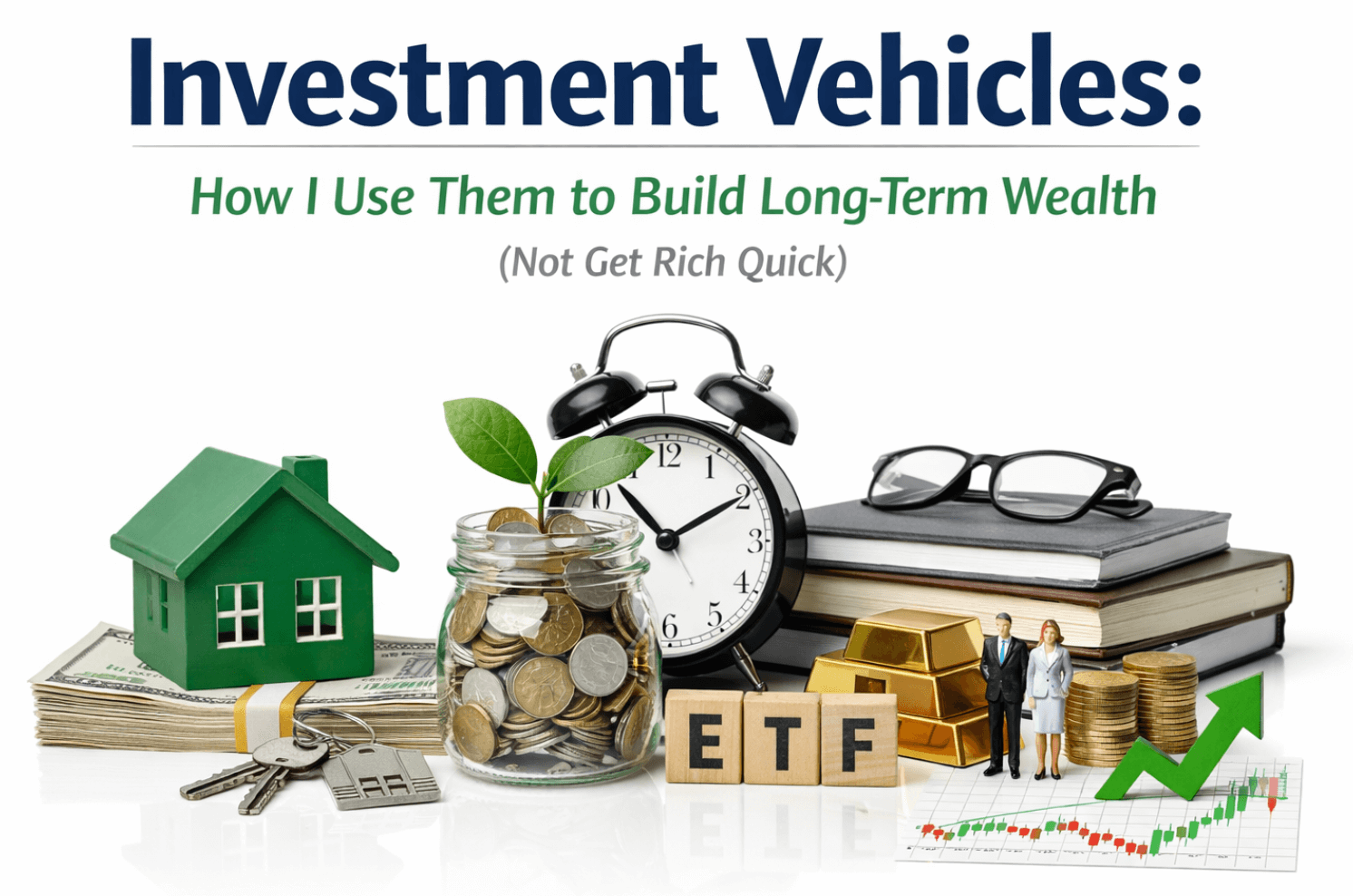
Stocks, bonds, ETFs, mutual funds, real estate, and retirement accounts are all investment vehicles. Each one moves money differently, exposes you to different risks, and rewards patience in different ways.
Most people confuse the vehicle with the destination.
They ask, “Which investment vehicle makes the most money?”
That’s the wrong question.
The better question is
Which investment vehicle aligns with my goals, time horizon, and temperament?
For example, a Ferrari is not a suitable vehicle for moving furniture, and a moving truck is not a suitable choice for racing.
Investment Vehicle vs. Investment Strategy
This distinction matters more than most people realize.
- Investment vehicle: Where your money sits
- Investment strategy: How you use it over time
You can have a brilliant strategy inside the wrong vehicle and still fail.
I’ve seen people with solid long-term goals use short-term vehicles—and burn out emotionally before compounding ever had a chance to work.
The vehicle sets the pace. And pace matters.
Why Investment Vehicles Exist
Investment vehicles exist to solve three fundamental problems:
- Time—They allow money to grow while you live your life
- Risk—They spread exposure instead of concentrating it
- Scale—They let small contributions turn into large outcomes
A good investment vehicle doesn’t excite you. It liberates you from constant decision-making.
The quieter the vehicle, the more powerful it usually is.
Why Most People Choose the Wrong Investment Vehicle
Most poor investment decisions aren’t caused by a lack of intelligence. They’re caused by emotion.
Emotional Decision-Making
Fear and greed push people into vehicles they don’t understand.
- Fear makes people hide in cash forever
- Greed pushes people into speculative assets they can’t hold through downturns
I’ve been on both sides.
The mistake isn’t feeling emotion; it’s choosing a vehicle that amplifies emotion instead of dampening it.
The best investment vehicles reduce the number of decisions you have to make when emotions are highest.
Confusing Speculation With Investing
Speculation is about predicting price movement.
Investing is about owning productive assets.
If the success of your investment vehicle depends on selling it to someone else at a higher price soon, you’re speculating, whether you admit it or not.
There’s nothing wrong with speculation if you call it what it is. The problem is building your financial future on it.
I don’t build PosterityWealth on predictions. I built it on ownership.
Ignoring Time Horizon
Time horizons are everything.
A vehicle that works beautifully for over 30 years can destroy capital in just 12 months. And a vehicle designed for short-term parking will fail miserably over the decades.
Most people never define their time horizon. They just chase returns and hope it works out.
Hope is not a strategy.
The Core Types of Investment Vehicles
Let’s walk through the most common investment vehicles, not from a textbook perspective, but from a real-world ownership mindset.
Stocks
Stocks represent ownership in a business.
That’s it. Nothing more. Nothing less.
The problem is that most people treat stocks like lottery tickets instead of ownership stakes. They buy because of headlines. They sell because of fear.
Stocks are powerful if you respect what they are.
- Best for: Long-term growth
- Risk: Volatility
- Reward: Compounding ownership
I prefer diversified exposure to stocks rather than betting heavily on individual companies. Ownership matters, but concentration increases emotional risk.
Bonds
Bonds are loans. You lend money and get paid interest.
They’re not exciting. And that’s precisely why they exist.
Bonds stabilize portfolios. They don’t build wealth quickly, but they protect it when volatility hits.
- Best for: Stability and income
- Risk: Inflation erosion
- Reward: Predictability
As wealth grows, stability becomes more valuable.
Mutual Funds
Mutual funds pool money and invest it professionally.
They were revolutionary when they appeared. Today, many mutual funds are expensive, opaque, and outdated, but some still offer value.
The biggest issue with mutual funds isn’t performance. It’s fees.
Fees quietly compound against you.
Exchange-Traded Funds (ETFs)
ETFs are one of the most powerful investment vehicles ever created.
They offer:
- Diversification
- Low fees
- Transparency
- Simplicity
ETFs allow you to own markets instead of trying to beat them.
This is where my bias lives.
Most long-term investors don’t need complexity. They need consistency.
ETFs reward patience brutally well.
Real Estate
Real estate is a physical investment vehicle.
It produces income, appreciates over time, and offers leverage, but it demands involvement.
Real estate is not passive. It’s illiquid ownership.
- Best for: Income and inflation protection
- Risk: Leverage, management, concentration
- Reward: Cash flow and appreciation
I see real estate as a business vehicle, not a set-and-forget asset
Retirement Accounts (401(k), IRA, equivalents)
These are wrappers, not investments.
The wrapper matters because taxes matter.
Tax-advantaged vehicles can double or triple long-term outcomes without changing the underlying investment at all.
Ignoring tax efficiency is one of the most expensive mistakes I see.
Alternative Investment Vehicles
This category includes commodities, private equity, crypto, and other non-traditional assets.
These vehicles can play a role, but they demand humility.
High upside comes with high uncertainty.
I treat alternatives as satellites, not foundations.
Active vs Passive Investment Vehicles
This is where philosophy enters.
Active Vehicles
Active vehicles require:
- Constant monitoring
- Emotional discipline
- Skill and time
Most people overestimate their ability to outperform consistently.
Activity feels productive. It rarely is.
Passive Vehicles
Passive vehicles do the opposite.
They:
- Reduce decisions
- Lower fees
- Increase consistency
Passive investing is not lazy. It’s strategic humility.
It acknowledges that time, not brilliance, is the real advantage.
My Bias Toward Passive Investing
I choose vehicles that let me live my life.
Wealth should support freedom, not replace one job with another obsession.
How I Choose the Right Investment Vehicle (My Framework)
I use a simple framework.
Step 1: Define the Goal
Is this money for:
- Growth?
- Income?
- Stability?
- Legacy?
A vehicle without a defined purpose will disappoint you.
Step 2: Define the Time Horizon
The longer the horizon, the more powerful the vehicle.
Time turns volatility into opportunity.
Step 3: Understand Risk Tolerance
Risk isn’t mathematical; it’s emotional.
If you can’t hold through downturns, the vehicle is wrong.
Step 4: Minimize Fees and Complexity
Complexity is not sophistication.
Simple investment vehicles perform better over time because they remain consistent and uncomplicated.
Investment Vehicles for Different Life Stages
Your 20s–30s
Time is abundant. Volatility is your ally.
Growth vehicles shine here.
Your 40s–50s
Balance becomes important.
You should strive for both growth and stability.
Near Retirement
Preservation and income dominate.
The vehicle shifts. The philosophy stays.
Investment Vehicles vs Income Streams
Not all investment vehicles produce income.
Some grow quietly. Others pay regularly.
You need both.
Growth builds future freedom. Income protects present stability.
Read: Multiple Streams of Income: How to Build Financial Security and Wealth
Common Investment Vehicle Mistakes I See
- Over-diversification
- Chasing performance
- Ignoring taxes
- Switching too often
Consistency beats cleverness.
Every time.
Are Investment Vehicles the Same for Everyone?
No.
But the principles are.
These principles include time, patience, ownership, and discipline.
Vehicles differ. Foundations don’t.
How Investment Vehicles Build Generational Wealth
Generational wealth isn’t built through returns.
It’s built through systems.
Vehicles that:
- Compound quietly
- Teach ownership
- Reduce emotional errors
Wealth lasts when the structure outlives the individual.
My Personal Investment Vehicle Philosophy
I prioritize:
- Ownership over activity
- Time over timing
- Systems over speculation
I wish I had learned sooner that patience pays better than intelligence.
FAQ: Investment Vehicles
What is an investment vehicle?
An investment vehicle is the structure or method used to invest money, such as stocks, ETFs, bonds, real estate, or retirement accounts.
The vehicle decides how your money is invested, how it grows, how much risk it takes on, and how accessible it is.
I consider investment vehicles to be containers. The quality of the container matters just as much as what you put inside it.
What is the best investment vehicle for beginners?
For most beginners, the best investment vehicle is one that is:
- Simple
- Diversified
- Low cost
- Easy to hold long-term
That usually means broad-market ETFs or diversified index funds held inside a tax-advantaged account when possible.
The goal early on is not maximum returns; it’s staying invested long enough for compounding to work.
Are ETFs better than mutual funds?
Often, yes.
ETFs tend to have:
- Lower fees
- Greater transparency
- More flexibility
That said, the vehicle itself matters less than how long you stay invested and how consistently you contribute. A decent mutual fund held for decades will outperform a “perfect” ETF that you abandon during volatility.
What is the safest investment vehicle?
There is no universally “safe” investment vehicle; only vehicles that are appropriate for a given time horizon.
- Short-term money needs safety and liquidity
- Long-term money can tolerate volatility
Many people confuse volatility with risk. True risk is being forced to sell at the wrong time because your vehicle didn’t match your timeline.
How many investment vehicles should I have?
Having fewer investment vehicles is more prudent than most people believe.
I believe in having:
- A small number of core investment vehicles
- Each serves a clear purpose
Too many vehicles increase complexity, decision fatigue, and emotional mistakes. Simplicity makes discipline easier, and discipline compounds better than optimization.
Can investment vehicles generate passive income?
Yes. Many investment vehicles are designed specifically for income, including:
- Dividend-paying stocks or ETFs
- Bonds and bond funds
- Rental real estate
- Income-focused retirement portfolios
That said, “passive” rarely means effortless. Every vehicle requires upfront decisions, discipline, and occasional maintenance.
What investment vehicle builds wealth the fastest?
This question is misguided and often leads many people into trouble.
The investment vehicle that builds the most wealth is the one you can stay committed to for decades, continue funding during downturns, and avoid emotionally abandoning.
Time beats speed. Consistency beats brilliance.
Are alternative investment vehicles worth it?
Alternative investment vehicles like commodities, private equity, or cryptocurrencies can play a role but only as a small, intentional portion of a well-built portfolio.
I don’t believe alternatives should form the foundation of long-term wealth. They are supplements, not substitutes, for proven ownership-based vehicles.
Should I change investment vehicles as I grow older?
Yes, but gradually.
As life stages change, so should the balance between growth, income, and stability. That doesn’t mean constantly switching strategies. It means adjusting the mix while keeping the core philosophy intact.
The biggest mistake is making dramatic changes based on fear rather than planning.
What’s the difference between an investment vehicle and an income stream?
An investment vehicle is how money is invested.
An income stream is what the investment produces.
Some vehicles focus on growth. Others focus on income. Long-term wealth usually requires both at different stages of life.
Do I need a financial advisor to choose investment vehicles?
Not necessarily.
What most people need first is:
- Clear goals
- A long-term time horizon
- Simple, low-cost vehicles
- Emotional discipline
An advisor can help, but no one can replace patience, consistency, and ownership thinking.
Final Thoughts: The Right Vehicle Changes Everything
Wealth is not built by chasing speed.
It’s built by choosing the right vehicle and staying inside it long enough for time to work.
Start simple. Stay consistent. Think long-term.
That’s how PosterityWealth is built.